
Why Is My Competitor Ranking Higher on Google Maps? A 2026 Diagnostic Guide
What if the competitor outranking you isn’t better at what they do, but simply sends clearer signals to Google? If you’re asking, “why is my competitor ranking higher on google maps,” look beyond your own reputation or service quality. Local visibility can vary with relevance, distance, prominence, and the searcher’s location.
That can feel unfair, especially when your business seems like the stronger choice. But changing everything at once won’t reveal what’s holding you back. A consistent comparison can help you spot gaps in your Google Business Profile, customer reviews, and local visibility, then prioritize eligible, policy-compliant improvements.
This guide explains how to compare your business with a competitor, separate location effects from areas you can influence, and track visibility over time. You’ll also see how Review Rank Ai’s Google Local 3-Pack Leaderboard can help you monitor ranking patterns, without promising to control Google’s results. The goal is a measurable plan, not guesswork.
Key Takeaways
- Google Maps visibility can change with the search query and searcher’s location, so compare like-for-like searches before drawing conclusions.
- To diagnose why is my competitor ranking higher on google maps, assess relevance, location context, and prominence separately rather than treating rank as one score.
- Compare direct local competitors using the same query and search location, then check profile accuracy, categories, reviews, and website information for useful gaps.
- Prioritize accurate profile information and a consistent, genuine review-request process instead of making changes based on guesswork or questionable promises.
- Review monitoring tools can help organize invitations, responses, and visibility tracking. Check supported integrations and workflows before relying on a specific connection.
Why a competitor ranks higher on Google Maps: understand the result first
Seeing a competitor above your business can sting, especially when you know you serve customers well. But one Maps result isn’t a verdict on your business. If you’re asking, “why is my competitor ranking higher on google maps,” start with a fair comparison: use the same search phrase, search location, and observation time before deciding there’s a ranking gap to fix.
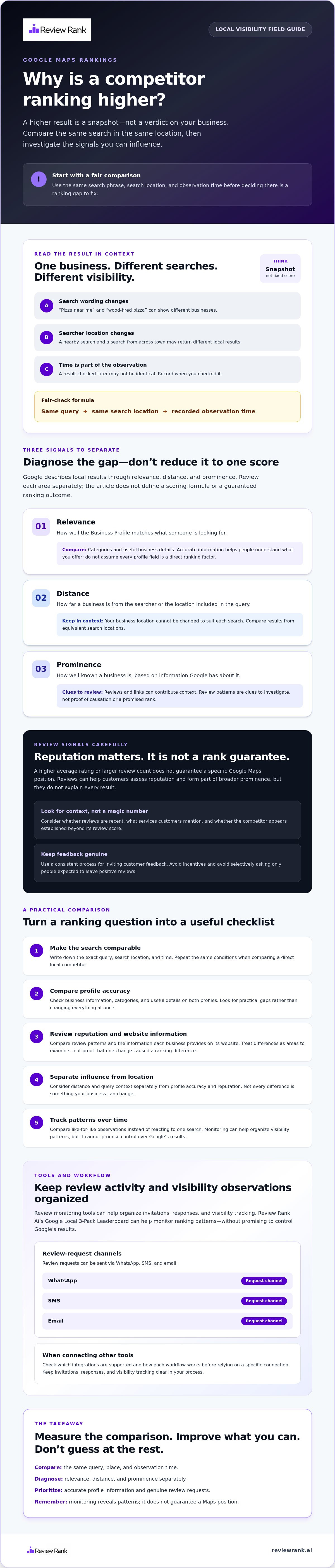
Local ranking is a context-dependent result, not a fixed score assigned to your business. Google Maps visibility can change with the words someone searches and where they’re searching from. A restaurant may appear prominently for “pizza near me” close to its address, yet show differently for “wood-fired pizza” or a search made across town. Treat each result as a snapshot, not a universal position.
What determines local visibility in Google Maps?
Google describes local results through three factors: relevance, distance, and prominence. Relevance is how well a Business Profile matches what someone is looking for. Accurate categories and useful business details help people understand what you offer, but don’t assume every profile field is a direct ranking factor. Distance refers to how far a business is from the searcher or the location included in the query. You can’t change where your business is located to suit each search. Prominence reflects how well-known a business is, based on information Google has about it, including signals such as reviews and links. These ideas also appear in this overview of Local search engine optimization.
Reviews can shape customer confidence and contribute to a business’s prominence, but they don’t guarantee a particular Maps position. A high review count alone can’t explain every result. The search phrase, distance, and other signals all matter.
Why can the same search show different businesses?
Google may show different local businesses for the same phrase when people search from different places. Query wording can also change which businesses appear: someone searching for “dentist” may see a different set of results from someone searching for “children’s dentist.” Even a result you check again later may not be identical.
That’s why one search from your own phone doesn’t establish a stable, universal rank. Record the exact query, the location used, and when you checked. Compare like-for-like observations over time instead of reacting to a single change. For more on reputation’s role in local visibility, see this local SEO reputation management guide.
How Google Maps ranking signals create a gap between two competitors
A ranking gap is rarely explained by one visible difference. Google describes local results through relevance, distance, and prominence. Compare those areas separately, then look for practical differences between the two profiles. This helps answer “why is my competitor ranking higher on google maps” without treating a star rating or profile checklist as a complete ranking formula.
A high star rating alone can’t prove that one business is more relevant, prominent, or likely to rank higher in every local search. Ratings and reviews help customers assess reputation, but they don’t guarantee a Maps position. Review volume, recency, and the topics customers mention can add context when comparing businesses. Treat them as clues to investigate, not a score you can calculate into a promised rank.
Does a higher Google review score guarantee a better Maps position?
No. A higher average rating or a larger review count doesn’t guarantee a specific position. Reviews can influence customer confidence and form part of a business’s broader prominence, but reputation and ranking are not interchangeable. Compare patterns thoughtfully: Are reviews recent? Do they describe services you offer? Does the competitor appear more established beyond its review score? These observations can shape a diagnosis, but they don’t prove causation.
Build a steady process for inviting genuine feedback from customers, without incentives or selectively asking only people expected to leave positive reviews. Consistency gives you a more useful picture of customer experience over time. It also keeps review generation focused on authentic feedback rather than chasing a target score.
How business profile accuracy and prominence affect the comparison
Check whether both profiles accurately represent the businesses. Compare the business name, primary category, address or service area, hours, and details that help customers understand the services available. Correct errors and outdated information, but don’t assume every field is a direct ranking factor. A mismatch can still confuse potential customers or make a profile less useful.
Then look beyond Maps. Credible local mentions and links may contribute to broader prominence, while consistent business details help people identify the same business across sources. For practical ideas on how to improve local search rankings, compare advice against your own evidence and avoid changing everything at once. This Google review and local SEO guide offers more context on reputation in search.
Track what you change and what happens next. A visibility-monitoring tool such as Review Rank Ai’s local ranking tools can help you observe patterns, but monitoring does not control Google’s results or guarantee improvement.
How to compare your Google Maps listing with the competitor above you
Start with a direct local competitor: a business serving the same area and customer need. A famous brand across the region won’t give you a useful benchmark if it serves a different market. Choose one competitor that appears above you for a relevant search, then compare what customers can actually see. The goal is to identify differences, not assume you’ve found the reason for a ranking gap.
Which competitor signals should you check first?
Use the same query and approximate search location for both businesses. Record the observation date, then compare these details side by side:
| Comparison point | Your listing | Competitor listing |
|---|---|---|
| Query and search location | Exact phrase and area searched | Same phrase and area |
| Profile accuracy | Name, address or service area, hours, and visible details | Check the same customer-facing details |
| Categories | Primary and additional categories | Compare category relevance to the query |
| Reviews | Note rating, volume, recency, and recurring themes | Record the same observations |
| Website evidence | Relevant services, location information, and contact details | Check for comparable information |
For a clinic, the comparison might be “physiotherapy near me” in the same neighbourhood. For a retailer, use a product or service phrase that reflects what nearby customers seek. Check whether each profile clearly matches the query, but don’t treat a complete profile or a particular category as proof of a ranking cause. Review themes and recency can reveal reputation differences, not a guaranteed ranking recipe.
How to interpret local ranking checks without false certainty
Separate what you observed from what you suspect. For example, “The competitor’s profile lists the service named in the query” is an observation. “That detail caused the higher position” is a hypothesis. One comparison can’t establish causation. It gives you a lead to investigate, not a verdict.
Keep a simple record for each check: query, date, approximate search location, and the businesses shown. Repeat the same checks under similar conditions and look for patterns across observations. If results shift, note the change instead of treating one result as a stable position.
A leaderboard can make repeated visibility checks easier to review, but it’s a monitoring tool, not a promise of improved placement. If you’re asking why is my competitor ranking higher on google maps, this comparison gives you evidence to guide the next step, without confusing a visible difference with a proven cause.
A practical action plan to close your Google Maps ranking gap
Turn your comparison into a short list of fixes, not a full profile overhaul. Work in order: validate the listing, correct clear mismatches, improve information that helps customers understand your business, then monitor results under consistent conditions. This makes it easier to see what changed without assuming any one update caused a ranking shift.
What to fix first when your profile is less relevant
Start with facts. Confirm that your business name, address or service area, hours, and categories accurately describe the business. Correct errors, then check that your services or products and location information are clear to prospective customers. Choose categories that genuinely fit what you offer, rather than adding unrelated categories to chase more searches.
Next, return to the comparison and address only gaps you can verify. If customers can’t find a service on your website, make that information clearer there. If reviews raise recurring questions or concerns, respond thoughtfully and address the issue where appropriate. A response can demonstrate that you’re listening, but don’t treat replies as a guaranteed ranking lever.
How to build a review process that earns trustworthy feedback
Invite customers consistently using neutral language. Ask for honest feedback, not a particular rating. Don’t offer incentives, discourage negative feedback, or selectively invite only customers you expect to be happy. A fair process gives customers the choice to share their experience without pressure.
WhatsApp, SMS, and email can support review invitations through the channels your business uses to communicate with customers. Choose an appropriate channel and keep the request straightforward. For example, a clinic or home service business could invite customers after an interaction with a simple request to share honest feedback. The aim is a consistent feedback process, not a promised position on Google Maps.
Before making changes, record a baseline: the query, approximate search location, date, visible results, and the specific profile or website gap you plan to address. Make a focused update, then repeat the same checks over time. Note what changed and when. Rankings can vary, so track patterns without setting an assumed deadline or treating a movement as proof of cause.
If you want a clearer view of local visibility patterns, track local visibility with Review Rank Ai. Its Google Local 3-Pack Leaderboard is a monitoring aid, not a ranking guarantee. Use it to observe results alongside your own notes, then decide what to investigate next.
How review monitoring, integrations, and Review Rank Ai fit the plan
Once you’ve identified a gap, software can help organize the work. Review Rank Ai supports reputation workflows with automated review invitations, AI-generated review responses, review repurposing for social media and websites, and a Google Local 3-Pack Leaderboard for monitoring visibility. Its negative feedback filtering can also support reputation management. These tools can help establish consistent processes, but they don’t change Google’s ranking decisions or guarantee a particular position.
Integrations are connections between tools that can help a workflow fit into how your team already works. Before relying on a connection, check the current Review Rank Ai integrations information for supported platforms and available functionality. Don’t assume a particular system sends customer details, review requests, or reporting data until the product documentation confirms that workflow.
What to verify before connecting review and business tools
Check which platforms are supported, what permissions a connection needs, how setup works, and what information moves between tools. After setup, test the steps that matter to your team: whether an invitation reaches its intended channel, whether review responses appear in the expected workflow, and whether reporting reflects the locations or activity you need to monitor. Confirm these details against current documentation, since integration availability and capabilities can change.
For a single-location business, that may mean checking one review-request process and one visibility baseline. A multi-location or franchise team may also need to confirm how each location is represented and whether the supported reporting matches its comparison needs. Don’t assume every business model uses the same setup.
When local ranking monitoring becomes useful
A leaderboard is most useful when you pair its observations with context. Track relevant searches and locations where supported, then note profile updates, website changes, and review-process activity alongside any visibility movement. That record helps you ask better questions about why is my competitor ranking higher on google maps, without mistaking correlation for proof that one action caused a change.
Review Rank Ai focuses on reputation workflows and visibility monitoring. It isn’t a full-service SEO agency, and a leaderboard can’t promise entry into Google’s top three results. Use monitoring to measure, learn, and decide what to investigate next.
Explore the local visibility platform to see how review workflows and local visibility monitoring may fit your process.
Turn your Maps comparison into a clear next step
If you’re still asking why is my competitor ranking higher on google maps, focus on evidence before making changes. Compare the same searches and locations, separate relevance, distance, and prominence, then fix verified profile or website gaps first. Reviews matter to customer trust, but neither a strong rating nor a software tool can guarantee a particular position.
Keep tracking consistent. Review Rank Ai’s Google Local 3-Pack Leaderboard helps monitor visibility patterns, while automated review invitations can support a steady feedback process. AI-generated review responses and review repurposing are also platform capabilities. These tools support reputation workflows, not control over Google rankings.
Explore Review Rank Ai’s local visibility tracking and review workflows to see how these capabilities may fit your process. With a measured approach and consistent follow-through, you can make better-informed improvements and build stronger local visibility over time.
Frequently Asked Questions
Why is my competitor ranking higher on Google Maps even though I have more reviews?
More reviews don’t automatically mean a higher Maps position. If you’re asking “why is my competitor ranking higher on google maps,” compare the same search query and location, then assess relevance, distance, and prominence. Review recency and what customers mention can provide context, but there’s no simple review-count formula that explains every result. Check for profile mismatches and whether the competitor more closely matches the searcher’s need.
Do Google reviews directly determine Google Maps rankings?
Reviews can contribute to a business’s prominence, but no single review score or count determines a specific Maps position. They also help potential customers judge a business’s reputation. Treat review activity as one part of the comparison, alongside relevance and distance, rather than a guaranteed ranking lever. Invite customers to share honest feedback consistently, and don’t offer incentives or selectively ask only customers expected to leave positive reviews.
Can my business rank higher than a competitor closer to the searcher?
Yes, it’s possible. Distance matters, but it’s one of several factors Google considers for local results. A business farther away may appear above a closer competitor if other signals better match the search, including relevance or prominence. You can’t control where a searcher is located, so compare results from consistent locations and focus improvements on factors you can verify, such as accurate business information and a clear match to customer needs.
How can I check my Google Maps ranking accurately?
Use the same search phrase and approximate search location each time, and record the date and businesses shown. Repeat the check under similar conditions instead of relying on one search from your own device. Results can vary by location and query, so treat each observation as a snapshot, not a universal rank. A leaderboard can help monitor visibility patterns where supported, but it doesn’t control or guarantee Google’s results.
How long does it take to outrank a competitor on Google Maps?
There’s no reliable timeline for outranking a specific business. Local results depend on several factors, including search context, and changes don’t guarantee a position shift. Start by recording a baseline, fixing verified profile inaccuracies, and addressing relevant gaps in your website or review process. Then repeat the same searches over time and document changes. Measure what you can observe rather than trusting promises of a fixed ranking deadline.
Can review management software improve my Google Maps ranking?
Review management software can help organize reputation workflows, but it can’t control Google’s ranking decisions or promise better placement. Review Rank Ai provides automated review invitations, AI-generated review responses, review repurposing, negative feedback filtering, and a Google Local 3-Pack Leaderboard for monitoring visibility. These capabilities can help you manage and observe your process. Use them alongside accurate business information and consistent comparisons, not as a substitute for diagnosing ranking gaps.
Can I send Google review requests through WhatsApp, SMS, and email?
Businesses can use WhatsApp, SMS, and email to request customer feedback, depending on the channels available to them. Keep requests neutral and invite genuine, honest reviews. Don’t offer incentives, discourage negative feedback, or ask only customers expected to respond positively. The purpose is to make feedback requests part of a consistent process, not to guarantee a particular rating or Google Maps position.