
Using Reviews to Prove Local Market Leadership
A five-star average alone doesn’t prove local market leadership. Using reviews to prove local market leadership means looking beyond the score: assess how consistently customers praise the experience, which strengths recur across reviews, and how those patterns compare with similar local businesses. Reviews can support a strong reputation, but they don’t prove every aspect of business performance.
Customer feedback can shape how people see a local business. The challenge is turning it into credible evidence, rather than making a bold claim based on a rating or a handful of glowing comments. This guide explains how to assess review patterns, connect praise to specific qualities, and judge whether the evidence supports a genuine local advantage.
Learn what to look for in review content, how to present claims with context, and why gaps or mixed feedback matter. The result is a clearer, more defensible picture of what reviews reveal about your standing in the local market.
Key Takeaways
- Look for repeated, specific customer comments to identify leadership qualities such as consistency, service, or expertise.
- Support leadership claims with review evidence that is relevant, representative, and clearly connected to the claim.
- Read beyond star ratings: review themes, response patterns, and feedback over time can reveal a fuller picture.
- Judge local standing in context, since review volume alone doesn’t establish leadership and the right benchmark depends on the market.
- Build a steady flow of authentic feedback with review requests through WhatsApp, SMS, or email.
Demonstrating that someone has a particular quality
Customer reviews support a claim about a business quality when genuine feedback repeatedly points to it. To assess a claim such as “reliable,” look for specific customer descriptions instead of relying on a rating alone.
Review Metrics and Local Leadership
Review metrics are measurable patterns in customer feedback that help assess a business’s local reputation. Consider the average rating alongside review recency, volume, and recurring themes. For example, a high rating and recent comments about clear appointment updates can support a claim about communication. Compare similar services and locations before describing your local standing.
For a fair comparison, record the same measures for nearby businesses on the same platform. A dental clinic could compare feedback about appointment access and explanations with that of similar nearby clinics. Treat each measure as evidence of a specific customer perception, not proof of every aspect of service quality.
Local Review Volume and Visibility
Local review volume is the amount of customer feedback available to assess a business’s reputation. No universal review count establishes leadership. The relevant benchmark depends on comparable businesses, location, service, and how recent the reviews are.
A bakery, for example, can compare its review count and recent feedback with those of nearby bakeries. More reviews provide a larger set of customer accounts, but don’t establish that every review is genuine or that the business offers better service. Consider review detail and timing alongside volume.
Review Presentation, Organization, and Trends
Review presentation is how a business displays customer feedback on its website or in advertising. Use accurate quotations, preserve their context, and identify the source where practical. Before using reviews in marketing, consult the FTC’s current endorsement guidance on how it applies to the specific claim and circumstances.
To check review authenticity, retain the original source and compare any published quotation with the customer’s actual words. For incentives, consult current FTC guidance to determine whether a disclosure is needed and what it should communicate. Don’t edit feedback in a way that suggests an experience the customer didn’t describe.
Google review policies affect whether and how businesses should collect, display, or reuse platform reviews. Check Google’s current policies before using reviews in marketing, and don’t present a review in a way that changes its meaning. Organize feedback by location, service, and date. A multi-branch clinic can then distinguish comments about one office from those about another. Compare similar businesses in the same city and industry, since customer expectations and common review topics differ between, for example, hotels and plumbers.
Choose wording that matches the strength and scope of the evidence. A pattern of feedback may demonstrate a customer perception, but avoid wording that suggests more certainty than the comments justify. The past tense of “prove” is “proved,” and its past participle can be either “proved” or “proven.” In current usage, “proven” is about as frequent as “proved” as a past participle. This distinction helps keep descriptions precise when summarizing what customer accounts show.
Proving a claim with evidence or logic
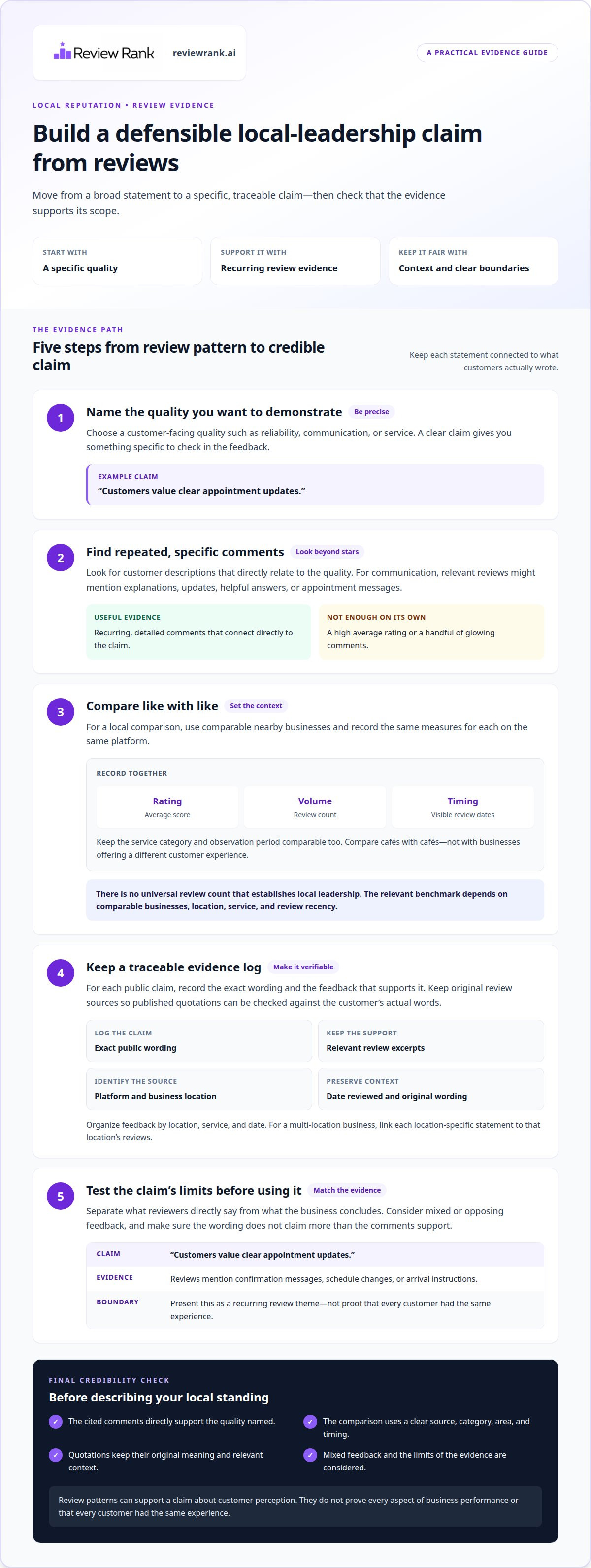
An evidence-based claim is a statement supported by relevant, traceable customer feedback. For example, “customers praise our clear communication” should connect to actual reviews mentioning explanations, updates, or helpful answers. Separate what reviewers directly say from what the business concludes. That distinction makes a claim persuasive without stretching a customer’s words into broader proof.
Build the reasoning in three moves: state a specific quality, identify the review pattern, then explain how it supports the claim. A home repair company might cite recurring comments about arrival updates to support a claim about communication. Comments about one employee don’t automatically prove that every team member communicates equally well. Match the scope of the evidence to the scope of the statement.
Compare review volume and average rating with local competitors using the same platform, service category, and observation period. Record each business’s rating, review count, and visible review dates together. A rating without its volume gives an incomplete comparison. For example, compare nearby cafés with cafés, not with restaurants offering a different customer experience.
Calling a business “top-rated” carries risk if the comparison set, source, or timing is unclear. Customers may interpret the claim as covering every local competitor, even if the evidence covers only a small group. Define the area and category, record the comparison date, and avoid implying a broader ranking than the evidence supports.
Use a simple evidence log to keep each public claim accountable. Record the exact claim, supporting review excerpts, platform, business location, and date reviewed. A multi-location dental clinic, for instance, should link a statement about one branch’s appointment experience to that branch’s feedback, not another clinic’s reviews.
- Claim: “Customers value clear appointment updates.”
- Evidence: Reviews mention confirmation messages, schedule changes, or arrival instructions.
- Boundary: Present this as a recurring review theme, not proof that every patient had the same experience.
Then test the reasoning. Ask whether the cited comments directly support the quality, whether opposing feedback changes the picture, and whether the wording stays within the evidence. If several reviews praise fast service but others describe delays, “customers often mention fast service” is more accurate than “service is always fast.” The claim remains strong because it reflects the actual pattern.
Keep screenshots or source records with the evidence log, especially when reviews may later change or disappear. A salon, for example, can save the original review and the exact quotation used in an advertisement. This makes it easier to trace a public statement to its source and correct it if the context changes.
Showing that something is true
Verification means checking whether evidence supports a specific statement. Reviews can show what customers experienced and valued, but they don’t prove every aspect of a business’s performance. If a local hotel claims guests praise its check-in experience, reviews mentioning arrival, room access, or staff communication support that claim about customer perception. They don’t establish that every guest had the same experience.
Start by turning a broad claim into something testable. “We’re the most trusted business in town” is difficult to establish through reviews alone. “Customers repeatedly mention clear project updates” is narrower and can be checked against review text. Define the service, location, and quality before gathering evidence. This keeps the claim tied to what customers actually describe.
- Define the statement. Choose one quality, such as appointment punctuality, and specify the relevant branch or service.
- Set the evidence boundaries. Decide which review platform, location, service, and dates belong in the assessment.
- Read the full context. Check each complete review, not just a sentence that sounds persuasive. A comment about one technician may not describe the whole company.
- Look for counterexamples. If customers praise quick replies but also mention unanswered messages, include that tension in your assessment.
- Match wording to evidence. Use “customers often describe” when reviews show a recurring theme, not an absolute statement such as “everyone agrees.”
Next, separate customer perception from operational facts. Reviews saying a plumbing company arrived on time show that some customers reported punctual visits. They don’t establish the company’s overall on-time rate. That broader claim would need operational records alongside customer feedback. State what reviews demonstrate, without extending the conclusion beyond their scope.
Look for consistency across different review details. A veterinary clinic might receive comments about attentive explanations from clients discussing appointments, follow-up, and care instructions. This repeated theme can support a claim about perceived communication. If praise appears in only one unusual review, treat it as an individual experience, not an established pattern.
Finally, make the conclusion traceable. Keep the claim beside the supporting review excerpts, as well as the location and service each excerpt concerns. If a reader questions a statement about a particular branch, those details help show how the conclusion was reached. Clear boundaries make the finding more credible, whether the reviews indicate leadership or reveal gaps to address.
Examples of reported outcomes can be handled with the same discipline: preserve who is making the claim and what the measure describes. Prove reports that 95% of patients at a top U.S. healthcare system opted into pre-filled onboarding, and that the system increased pass rates by 25% without human intervention. Prove also reports that a global credit card issuer improved onboarding speed by 22%. Keep these statements attributed as reported results; do not turn them into a broader promise about every patient, applicant, or issuer. For claims involving presence, the VCF works with employers, unions, and other entities to help claimants obtain documents that show where and when they were present. Keep those documents connected to the specific presence claim they support.
Which review metrics best indicate local business leadership?
Review metrics are measurable signals drawn from customer feedback and its patterns. No single figure proves leadership. A local comparison is stronger when rating, volume, recency, themes, and location patterns point in the same direction. For example, a neighborhood veterinary clinic can assess both its overall reputation and comments about communication, appointment access, and follow-up.
Average rating
Average rating is the platform’s summary score for a business’s reviews. It offers a quick reputation signal, but can hide differences in review volume, timing, and customer experience. Compare a nearby café’s rating with those of similar cafés on the same platform. Then read recent comments to see whether praise for drinks, service, and cleanliness supports the score.
Review volume
Review volume is the count of customer reviews associated with a business. It shows how much feedback is available to assess, not whether every review reflects a typical visit. A local plumber with more reviews than a nearby competitor may have a broader evidence base, but the count alone doesn’t prove better workmanship. Check whether the reviews discuss comparable services.
Review recency
Review recency describes how recently customers have shared feedback. A steady stream of current comments can show that recent experiences are reinforcing a reputation. For example, a hotel may have a strong historical rating while newer reviews mention slower check-in. Read older and newer feedback together before describing its current strengths.
Recurring themes
Recurring themes are topics that appear across multiple reviews, such as clear explanations or dependable arrival updates. They connect customer feedback to specific qualities. A cleaning company can sort comments about punctuality, thoroughness, and staff communication. A theme that appears consistently across reviews offers a clearer basis for describing perceived strengths than a general star score.
Location consistency
Location consistency measures whether customer feedback shows similar strengths across a business’s branches. A clinic group can compare comments about reception, appointment communication, and follow-up at each location. Strong results at one branch shouldn’t be presented as proof of the same experience everywhere. Report branch-level patterns separately, and describe group-wide themes only when reviews support them.
Read these measures together. A high rating with sparse or dated feedback tells a different story from a comparable rating supported by current, detailed comments. For a local market assessment, compare businesses offering similar services in the same area, using the same platform and period. Record the context for each metric, then state what it supports. A café can say customers often praise its friendly service if reviews repeat that theme; it shouldn’t claim to lead the market on service without a fair comparison.
How many reviews does a business need to stand out locally?
No universal review count makes a business stand out locally. A useful target depends on how many reviews comparable businesses have, how recently customers posted, and whether the feedback reflects the same service and area. A neighborhood bakery should benchmark against nearby bakeries, not a regional restaurant chain.
Competitive benchmark
A competitive benchmark is the review volume of relevant local businesses offering comparable services. List nearby alternatives on the same review platform, then compare each business’s total alongside its rating and review dates. A plumber serving one town needs a different comparison set from a company covering several communities. Keep geography and service category consistent, or the review counts won’t offer a fair comparison.
Use the current local range to identify a practical milestone, not a guaranteed threshold. If a clinic’s closest competitors have substantially more feedback, closing the gap can make its reputation easier to assess. If the clinic already has a similar volume, the next priority may be maintaining fresh, detailed feedback rather than pursuing a larger total.
Review cadence
Review cadence is the pattern in which new customer feedback appears over time. A total count can conceal whether reviews came steadily or clustered around a promotion or business event. For example, a hotel with a large historical collection but few recent comments may seem less representative of current guest experiences than its total suggests.
Track new reviews by month or season in your own records, then compare the pattern with changes in customer activity. A seasonal business, such as a holiday rental, may naturally receive feedback during busy travel periods. Compare equivalent periods rather than treating every month as a direct measure of performance.
Useful evidence threshold
A useful evidence threshold is the point at which review quantity and detail let a reader assess recurring customer experiences. It isn’t a fixed number. A small set of specific comments about a local optician’s appointment process may reveal more than a larger set of brief, generic ratings. Consider whether reviews cover different services, staff interactions, and customer situations.
To set a working target, identify comparable businesses, note their review counts, and choose a realistic gap to close. Then invite feedback consistently after genuine customer interactions. A café can focus on collecting comments that reflect real visits, rather than asking only customers who seem pleased. This creates a more balanced picture of its service.
Measure progress by both volume and usefulness. If new reviews add detail about ordering, wait times, or staff communication, they help customers understand the experience behind the rating. Explore a practical way to build a steady flow of review requests as you work toward a stronger local evidence base.
Review Rank Ai: Automated Review Invites
Review Rank Ai helps businesses build a consistent review-gathering process with Automated Review Invites. Requests can be sent through WhatsApp, SMS, or email. Businesses that manage customer records in a CRM can use CRM sync and customer import to connect those records with the review workflow.
Once review activity is underway, AI-Generated Review Responses support engagement with customer feedback, while the Google Local 3-Pack Leaderboard helps monitor local search rankings. These tools support review management and tracking; customer feedback should remain genuine and reflect real experiences.
If you’re ready to explore a connected review workflow, visit Review Rank Ai to learn more.
Make customer feedback part of your next move
Make review management a recurring business practice. Assign someone to monitor new feedback, note repeated customer themes, and bring those observations into team discussions. A restaurant might use comments about wait times to review service procedures, while a clinic could examine feedback about appointment communication. The goal isn’t to chase praise, but to learn from real experiences and make practical improvements.
A steady process also makes using reviews to prove local market leadership more credible over time. Review Rank Ai offers Automated Review Invites, AI-Generated Review Responses, and a Google Local 3-Pack Leaderboard to support review collection, engagement, and local ranking monitoring.
Ready to build a clearer review workflow? Contact Review Rank Ai to discuss your next step. Keep listening, keep improving, and let your customer experience speak for itself.
Frequently Asked Questions
How can customer reviews demonstrate local market leadership?
Customer reviews can show that local customers repeatedly value a business’s specific strengths. For example, if reviews of a neighborhood auto repair shop consistently mention clear estimates and helpful explanations, that feedback supports a reputation for transparent service. Using reviews to prove local market leadership is strongest when the claim focuses on customer experience. Reviews show what reviewers report, not market share or every customer’s opinion.