
The Cost of Ignoring Customer Reviews: What Businesses Lose in 2026
What does an unanswered review really cost your business? The cost of ignoring customer reviews rarely arrives as a single bill. It can show up in a prospect’s first impression, a customer choosing a competitor, or feedback that never reaches the team that could fix the problem.
It’s also true that review monitoring and thoughtful replies take time, especially when daily operations already demand attention. And without a clear way to track what happens after a review, it’s hard to separate measurable impact from guesswork.
This article breaks down the potential costs across customer trust, buying decisions, local visibility, and operations, without treating industry estimates as guaranteed losses. You’ll learn a practical way to assess your own review risks and opportunities, then build a manageable process for monitoring and responding. We’ll also explore how review workflows can fit with existing tools, including invitations sent by WhatsApp, SMS, or email. The goal is simple: turn reviews from an overlooked task into a signal your business can track and act on.
Key Takeaways
- The cost of ignoring customer reviews can include lost confidence, added friction in customer decisions, weaker local discovery, and missed operational insight, but the impact varies by business.
- Use your own review, lead, conversion, and service data to assess potential impact, and separate observed patterns from estimates.
- Build a repeatable workflow to invite feedback, monitor reviews, respond thoughtfully, route service issues, and spot recurring themes.
- Choose a review management approach that fits your review volume, locations, response needs, and existing tools.
- Connect review invitations with customer workflows using available channels such as WhatsApp, SMS, and email, and use integrations to help coordinate review activity with other tools.
What Is the Cost of Ignoring Customer Reviews?
The cost of ignoring customer reviews is the potential business impact of failing to monitor, acknowledge, investigate, or learn from customer feedback. It isn’t a fixed bill, and a review alone can’t prove why a customer chose one business over another. The impact depends on factors such as industry, location, competition, and individual customer behavior.
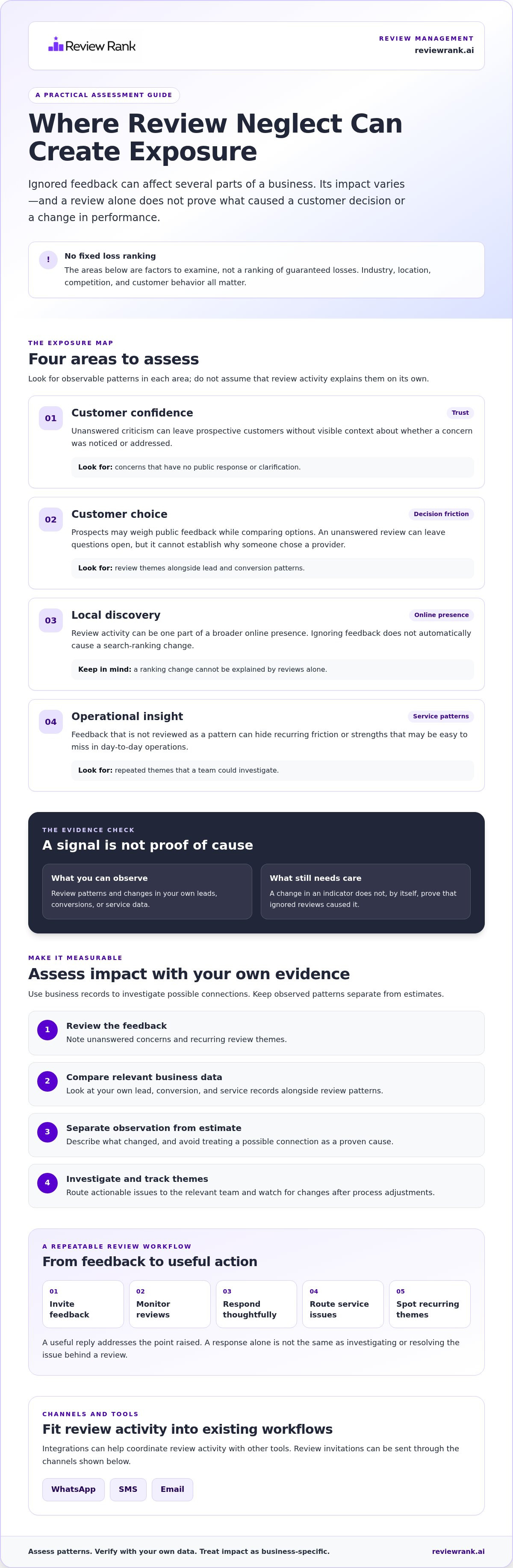
Reviews can shape four areas of exposure:
- Trust: An unanswered concern may leave readers unsure whether the business takes feedback seriously.
- Customer choice: Prospects may weigh public feedback as they compare their options.
- Local visibility: Review activity is one part of a broader online presence, but ignoring feedback does not automatically cause a ranking change.
- Operational insight: Repeated comments can reveal service issues or strengths that are easy to miss when feedback isn’t reviewed as a pattern.
What counts as ignoring a customer review?
Ignoring isn’t limited to leaving a review unanswered. A business may reply yet fail to investigate or resolve the issue behind it. It can also mean overlooking positive feedback or never analyzing recurring themes. Customer reviews are public feedback, but their reliability and meaning can vary. A relevant, specific response is more useful than generic text that doesn’t address what the customer actually said.
Why can unanswered reviews matter before a customer contacts you?
Prospects may read public feedback while comparing nearby businesses, providers, or products, before they call, book, or visit. A response can show that feedback has been noticed; silence may leave questions unanswered. Still, reviews are only one signal among price, convenience, personal recommendations, and other considerations. Understanding automated reputation management software can help businesses consider how monitoring and response tasks fit into a consistent workflow.
That distinction matters when calculating the cost of ignoring customer reviews. Treat possible lost trust, customer choice, local discovery, or operational learning as exposure to investigate, not a guaranteed loss. Start with what your business can observe, then compare review patterns with relevant customer and service data. The next step is to estimate impact using your own evidence rather than assume every unanswered comment caused a specific outcome.
Where Businesses Can Lose Ground When They Ignore Reviews
Review neglect can create several kinds of exposure, but none should be treated as an automatic loss. A customer’s decision or a business’s local visibility depends on more than reviews. The useful question is whether review patterns align with changes in your own business indicators.
Measurable indicators show what changed; they don’t, by themselves, prove that ignored reviews caused the change. Keep that distinction in view as you assess four areas:
- Customer confidence: Unanswered criticism can leave prospective customers without visible context about whether the business noticed or addressed a concern.
- Conversion friction: A prospect weighing options may have unanswered questions after reading a review, prompting them to seek more information or consider another provider.
- Local discovery: Review activity may be one part of a business’s online presence. It doesn’t guarantee a particular search position or explain a ranking change on its own.
- Operational insight: Unreviewed feedback can hide recurring points of friction that staff could investigate and potentially improve.
How ignored reviews may affect customer trust and choice
Hypothetical scenario: A person comparing local clinics reads a review describing a confusing booking process. The clinic hasn’t replied, so the public page offers no indication that the concern was seen or clarified. That silence might affect the reader’s confidence, but it doesn’t establish why they choose a clinic. A timely, specific response can demonstrate attention without guaranteeing a booking or retaining that customer.
Responses should address the point raised, not merely fill a blank space. Avoid sharing private details, and don’t try to bury honest criticism. The Federal Trade Commission’s guidance on the Consumer Review Fairness Act explains protections related to honest customer reviews and businesses’ attempts to restrict them.
What review neglect can hide from the business
Hypothetical scenario: A home-service company notices several reviews mentioning uncertainty about appointment arrival windows. Each comment may describe a different experience, but together they could point to a communication step worth checking. Comparing review themes with scheduling records or customer-service contacts can help the team decide whether a process needs attention.
This is where reputation work can inform operations, not just public perception. Track themes, route actionable issues to the right team, and look for changes after process adjustments. For a broader view of how reviews connect with local presence, explore local reputation management. The cost of ignoring customer reviews is best assessed through this kind of evidence, not assumed from a comment or a ranking alone.
How to Estimate the Cost of Ignoring Customer Reviews
A useful estimate starts with your own records, not an industry average. A cautious, business-specific estimate needs review activity, response coverage, lead and conversion trends, customer-service records, and a clearly defined comparison period. Even with those inputs, treat the result as an estimate: correlation between review activity and business outcomes doesn’t prove that one caused the other.
Build an estimate from your own data
- Set a comparison period. Choose a consistent timeframe and use the same dates when reviewing feedback, leads, conversions, and service issues. Note seasonality, promotions, price changes, and other marketing activity that could affect results.
- Record review activity. Track review volume, how many reviews received a response, response timing, and recurring themes. Separate unanswered feedback from reviews that received a reply but point to an unresolved issue.
- Compare customer trends. Review lead inquiries, bookings or sales, and conversion rates over the same period. If your records show how customers found you, compare those channels carefully rather than assuming all changes relate to reviews.
- Log service patterns. Note recurring complaints, the teams or processes they relate to, and how long service issues take to resolve. Use existing support or service records where possible. Don’t assign a financial value unless your own records support it.
- Review local visibility separately. Record changes in local search presence alongside review activity, but consider other possible influences. A Google Local 3-Pack position is an indicator to monitor, not proof that reviews alone caused a change.
Keep observations separate from assumptions
Create two columns: Observed and Estimated. Put recorded review counts, response coverage, inquiries, conversions, and service-resolution times in the first. Put any modeled or inferred impact in the second, and state the assumptions behind it. For example, if you estimate that some inquiries might have converted, identify the conversion rate from your own relevant records and label the result as an estimate, not a confirmed loss.
Don’t attribute every rise or fall in leads, sales, or rankings to reviews. Compare periods with care, account for other changes, and avoid presenting a hypothetical calculation as a typical outcome. The cost of ignoring customer reviews becomes more useful as a decision-making measure when each assumption can be checked against business records.
For local businesses, reviewing visibility alongside review activity can add context. Learn what the Google Local 3-Pack leaderboard can help you monitor, then interpret those observations alongside your other business data.
How to Reduce Review Neglect with a Practical Workflow
A repeatable process makes review work easier to fit around daily operations. Assign ownership, decide where feedback goes, and set a regular cadence that matches your business. The goal isn’t to reply with speed at any cost. It’s to make sure feedback is seen, handled appropriately, and used.
- Invite: Send a clear, neutral request after a customer interaction. Choose WhatsApp, SMS, or email based on how your business already communicates with customers. Invite honest feedback without asking for a positive rating or steering customers away from public reviews.
- Monitor: Give someone responsibility for checking incoming reviews. A shared view or established routine can help prevent feedback from being overlooked.
- Respond: Address the customer’s actual point. AI-generated response tools can assist with drafts, but review each reply for accuracy, relevance, and an appropriate tone before using it.
- Route issues: Send service concerns to the team member who can investigate them. Keep the public response considerate, and handle private or sensitive details through an appropriate channel.
- Review themes: Look for repeated comments and share useful patterns with the people responsible for service, communication, or operations.
How do requests work across WhatsApp, SMS, and email?
These channels give businesses options for fitting review invitations into customer communication. A business might use the channel that best matches its existing follow-up process, while keeping the request straightforward and optional. Use neutral language that welcomes honest feedback from every customer. Review the current guidance for each relevant platform before setting solicitation practices, and avoid incentives or selective requests designed to produce only positive reviews.
How can integrations reduce manual review work?
Where supported, integrations can connect review activity with other business tools and make it easier to include invitations or feedback follow-up in an existing workflow. The exact tools and connection behavior depend on current integration support, so avoid assuming a particular data flow. The practical aim is consistency: reduce repeated manual steps while preserving human oversight. AI-assisted responses can help prepare replies, but a person should ensure each one accurately addresses its review.
A manageable workflow can make the cost of ignoring customer reviews easier to control by turning scattered tasks into a process the team can follow. Review Rank Ai supports review invitations through WhatsApp, SMS, and email, along with AI-generated response assistance. Explore review management tools to see how these capabilities may fit into your workflow.
Choosing a Review Management Approach That Fits Your Business
The right approach is the one your team can sustain. A person handling a manageable flow may have enough time to read each review, reply with context, and pass service issues to the right colleague. As review volume or location count grows, the same routine can become harder to keep consistent. Choose based on observed workload, not fear of what might happen.
When is manual review management enough?
A simple manual process can work when one person can reliably monitor the relevant review channels, respond appropriately, and follow up on customer concerns. Use a shared schedule or task list so ownership is clear. Signs the process is under strain include reviews being missed, replies becoming inconsistent, or internal follow-up getting delayed. Those are practical reasons to reassess, not proof that every business needs automation.
What should an automated review workflow help you manage?
Basic monitoring can make new feedback easier to notice, while an automated platform can bring more review tasks into a repeatable workflow. Review Rank Ai supports review invitations through WhatsApp, SMS, and email; AI-generated response assistance; a Google Local 3-Pack Leaderboard for visibility monitoring; negative feedback filtering; and automatic review repurposing for websites and social media.
Integrations can also matter. When supported, connections with existing business tools may help fit review requests and follow-up into workflows the team already uses. Check current integration support before relying on a specific connection or data flow. The aim is to reduce repeated manual steps, not remove oversight.
Automation still needs a human check. Review AI-assisted replies for accuracy and relevance, route sensitive issues to the right person, and make sure feedback is handled fairly. Negative feedback filtering should help teams manage or identify feedback, not suppress or gate public reviews. Review reuse should also preserve the meaning and context of the original customer feedback.
Compare approaches against your review volume, number of locations, response needs, and existing tools. If a manual routine is working, keep it. If missed reviews or uneven follow-up are becoming a pattern, consider a more structured system. The cost of ignoring customer reviews is best addressed with a process your team can maintain, not a promise of guaranteed rankings, revenue, or savings.
Explore review management automation to see how review invitations, response assistance, visibility monitoring, and review reuse can support a consistent workflow.
Make Customer Feedback a Consistent Part of Your Process
The cost of ignoring customer reviews isn’t a guaranteed loss you can calculate from a single comment. It’s potential exposure across customer confidence, decisions, local visibility, and operational insight. Use your own review, lead, conversion, and service records to spot patterns, and keep observed results separate from assumptions.
Then choose a process your team can maintain. A simple manual routine may be enough for a manageable review flow. As volume, locations, or response needs grow, automation can help organize invitations, monitoring, and follow-up while leaving people in control of context and sensitive replies.
Review Rank Ai supports invitations through WhatsApp, SMS, and email, AI-generated review responses, a Google Local 3-Pack Leaderboard, and review repurposing for websites and social media. Integrations can help connect review activity with other tools where supported, so the workflow can fit existing operations without promising a particular business outcome.
Explore review management automation and find a practical way to keep feedback visible, actionable, and easier to manage. Small, consistent steps can help your team learn from every review.
Frequently Asked Questions
Can ignoring negative reviews hurt a business?
Yes, unanswered negative reviews may leave prospective customers without visible context about whether the business noticed or addressed a concern. They can also leave the business unaware of a recurring issue that deserves investigation. A relevant, professional response can show attention, but it can’t guarantee a customer will stay or choose you. Treat criticism as feedback to assess, not something to hide or automatically dismiss.
Do unanswered reviews affect local search rankings?
Unanswered reviews don’t prove that a business will lose local search visibility or explain a ranking change on their own. Reviews and responses are part of a broader online presence, alongside other factors that can influence local discovery. Monitor review activity and local visibility over the same period, but don’t assume one caused the other. A leaderboard can help track visibility; it can’t guarantee a particular position.
How much revenue can a business lose by ignoring reviews?
There’s no reliable universal amount to assign. The effect depends on the business, market, customer behavior, and other factors that influence purchases. To build a cautious estimate, compare your review and response records with leads, conversions, and customer-service data over a defined period. Label assumptions clearly, account for seasonality and marketing changes, and don’t present a correlation as proof that reviews caused a revenue change.
Should businesses respond to every customer review?
A consistent, thoughtful response process is valuable, but replies should be relevant rather than generic. Prioritize reviews that raise specific concerns, need clarification, or point to a service issue, while acknowledging positive feedback where practical. Make sure responses reflect the actual review and don’t disclose sensitive details. If volume makes timely replies difficult, define who monitors feedback and how unresolved issues reach the right team.
Can review requests be sent through WhatsApp, SMS, and email?
Yes. Review invitations can be sent through WhatsApp, SMS, and email. A business can choose the channel that fits its existing customer communication process and send a clear, neutral invitation for honest feedback. Requests shouldn’t pressure customers toward positive reviews or discourage public criticism. Before setting up solicitation practices, follow the current guidance for the review platform and communication channels you use.
Can review management software respond to reviews automatically?
Review management software can use AI to generate responses, helping teams prepare replies more consistently. Review Rank Ai provides AI-generated review responses, but human oversight remains important: check each response for accuracy, context, tone, and sensitive details before using it. Integrations may connect review activity with other tools where supported, but the workflow and connected tools depend on current integration support.