Restaurant Review Management: Winning Guest Trust
A busy service can fill every table and still leave your review page unanswered. That’s why review management for restaurants needs to fit the rhythm of service, not rely on someone remembering one more task at the end of a shift.
Guest feedback matters, and a consistent process helps you gather it without putting pressure on diners or adding friction for staff. The challenge is familiar: requests get missed, a complaint may reach the wrong person, and each location or platform can feel like a separate inbox.
This guide shows you how to build a repeatable, guest-friendly workflow, from sending review invitations through WhatsApp, SMS, or email to using AI-generated responses as drafts that your team can review, especially when feedback is sensitive. You’ll also see how negative feedback filtering fits into responsible review management, and how integrations can connect review activity with the tools your restaurant already uses. We’ll look at Review Rank Ai’s listed integrations with platforms such as Google Business Profile, OpenTable, DoorDash, and Uber Eats, plus ways to monitor local visibility and reuse reviews on your website or social media. The goal: a steady process that protects your restaurant’s voice and keeps feedback from slipping through the cracks.
Key Takeaways
- Build review management for restaurants around the guest journey, with clear ownership so invitations and follow-ups don’t get lost between shifts.
- Compare manual, single-channel, and automated approaches by workload, channel coverage, integrations, and multi-location needs.
- Use a consistent response standard: address the specific feedback, keep the restaurant’s voice, and route sensitive complaints to a manager.
- Review Rank Ai can support the workflow with automated invitations, AI-generated response drafts, feedback filtering, and review repurposing.
- Check how integrations fit your existing restaurant tools so review activity is easier to manage across locations and platforms.
Why restaurant review management needs a service-aware workflow
A restaurant’s feedback doesn’t arrive in one tidy queue. A dine-in guest may post publicly after dinner, a delivery customer may leave feedback on an ordering platform, and a reservation guest may send a direct message about a missed request. If each signal lands somewhere different, teams can lose track of what needs a reply and what could help improve service.
Restaurant review management is the repeatable process of collecting, monitoring, responding to, and learning from guest feedback across the channels and service moments where it appears. It’s more than replying to comments. A useful workflow connects feedback to a clear owner and a next step, while keeping public responses consistent with the restaurant’s voice.
Where restaurant reviews appear in the guest journey
The service context shapes what a guest may comment on. Dine-in feedback might mention table service or the atmosphere; takeaway feedback could focus on order accuracy and packaging; delivery feedback may describe the meal after it arrives. Reservation-related feedback can involve booking communication or how a request was handled. These are examples, not assumptions about what every guest values.
Some feedback appears publicly on review platforms. Google Business Profile and Google Maps are two places restaurant teams may monitor. Other feedback comes directly through channels such as a restaurant’s own email, contact form, or conversation with staff. Direct feedback can alert a team to an issue, but it isn’t the same as a public review. The wider history of Restaurant ratings includes guidebooks as well as consumer-written reviews, making it useful to distinguish professional assessments from individual guest experiences.
Locations add another layer. A group with several restaurants may share a name and service standards, but each venue has its own guests, team, and operating context. A complaint about one location shouldn’t be lost in a general inbox or answered as if it came from another branch.
What a restaurant review workflow should accomplish
A service-aware system makes review activity manageable without turning it into another task competing with the rush. Set a few practical goals:
- Timely invitations: Make requests a planned part of the guest journey, using neutral language rather than pressure.
- Clear ownership: Assign responsibility by role, shift, or location so incoming feedback has someone accountable for reviewing it.
- Consistent replies: Establish a tone and escalation path, while leaving room for a manager to handle sensitive or complex concerns.
- Useful learning: Look for recurring themes in guest comments, then share relevant observations with the team that can act on them.
Without these basics, missed messages can create operational blind spots: a recurring concern may go unnoticed, or a guest may not receive a response because ownership was unclear. That doesn’t prove a specific business outcome, but it does limit the team’s view of what guests are reporting.
Keep the scope focused. Reputation monitoring means tracking and responding to feedback; it isn’t the same as broader SEO or social media management. For a closer look at how software can support repeatable review tasks, explore automated reputation management software.
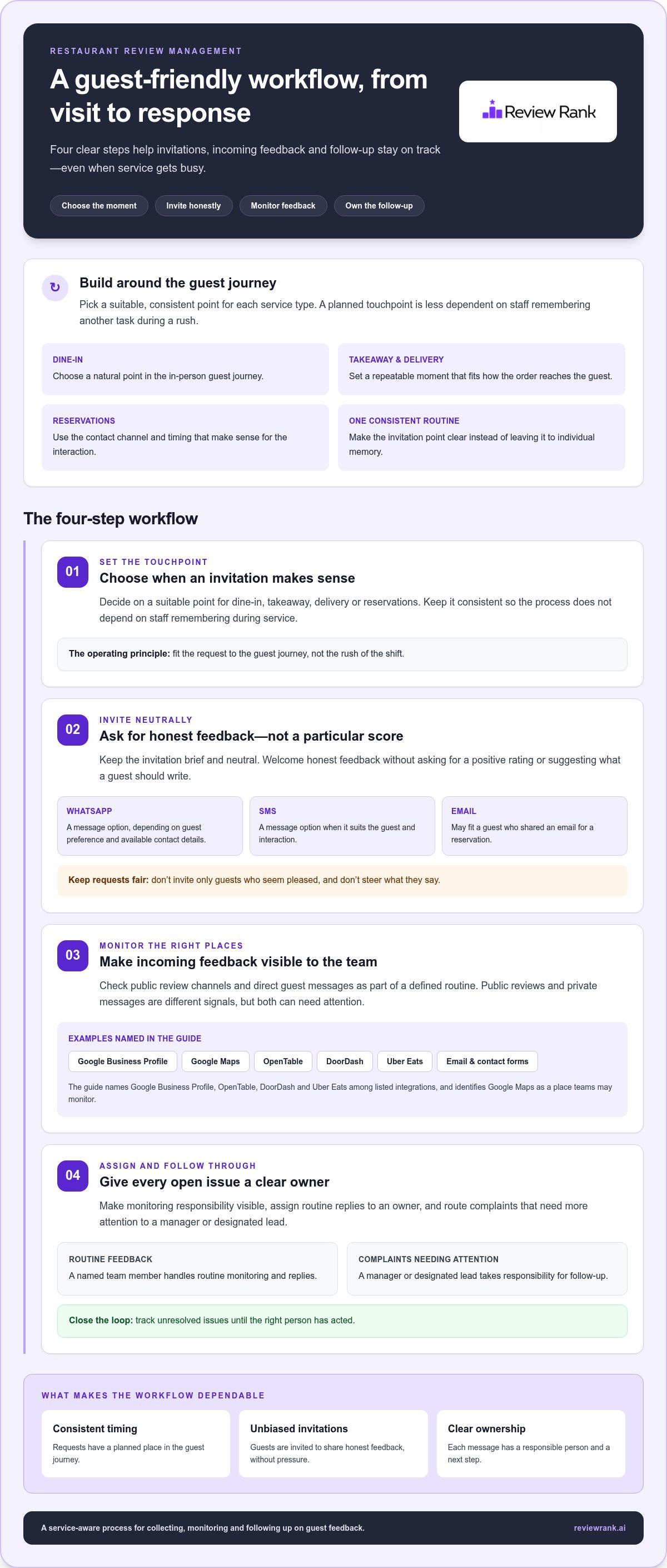
Building a Restaurant Review Workflow: Visit to Response
A reliable process gives every review request and open issue a clear next step. Build the routine around service, then assign responsibility so it keeps moving when the dining room gets busy or shifts change.
- Choose a suitable guest touchpoint. Decide when an invitation makes sense for dine-in, takeaway, delivery, or reservations. Use a consistent point in the guest journey rather than relying on individual staff to remember.
- Send a neutral invitation. Ask guests to share honest feedback. Don’t request a positive rating, suggest what they should write, or invite only guests who seem pleased. Consistent, unbiased requests help keep the process fair.
- Monitor incoming feedback. Check public review channels and direct guest messages as part of a defined routine. Make the monitoring responsibility visible to the team, not an informal task that everyone assumes someone else handles.
- Assign follow-up. Set a clear owner for routine replies and a manager or designated lead for complaints needing further attention. Track unresolved issues until the right person has acted.
Choose request channels that fit restaurant operations
WhatsApp, SMS, and email give restaurants different ways to invite feedback. Choose among them based on guest preference and the contact details available for that interaction. A guest who provided an email for a reservation may be better reached there; another may be more comfortable with a message. Keep the invitation brief and neutral, and make it clear that honest feedback is welcome, not a particular score.
Automated review invites can reduce reliance on staff remembering each request during a rush. They support a repeatable process, while the restaurant still defines its approach and remains responsible for following each review platform’s current policies. For a wider look at how automation supports review activity, see this guide to automated reputation management software.
Connect review activity with existing restaurant tools
Integrations can help review workflows sit alongside the platforms a restaurant already uses, rather than becoming a separate operational island. Review Rank Ai lists restaurant-related connections including Google Business Profile, OpenTable, Zomato, Keeta, Deliveroo, Careem, DoorDash, and Uber Eats. The integration listing identifies connected platforms; don’t assume a particular data flow or automatic trigger without documented details.
For a multi-location group, mapping the tools each venue uses can clarify where review activity belongs and who should monitor it. Keep the setup grounded in the actual systems in operation. If you’re shaping a repeatable review management for restaurants process, Review Rank Ai’s review management tools bring invitations and review activity into one workflow.
How to compare restaurant review management approaches
The right setup isn’t automatically the one with the most features. Compare how each approach handles the work your restaurant actually needs, from collecting feedback across channels to giving the right person a clear view of what needs attention.
Choose the workflow your team can sustain across shifts. A powerful system that staff can’t consistently use won’t solve a process that breaks during service.
Manual process: Staff check review sites and track requests or replies themselves. It offers direct control, but coverage and follow-through can depend on who’s working and how busy the shift is.
Single-channel tool: A focused tool can help manage feedback in one place or support a specific channel. It may simplify one task, but check whether other sources and locations still require separate monitoring.
Automated platform: A broader platform may support invitations, response assistance, integrations, and reporting. Evaluate which capabilities are demonstrated and relevant to your workflow, rather than assuming automation will remove the need for staff oversight.
Use the same criteria for each option: channel coverage, response support, connections with existing systems, reporting, multi-location visibility, and the workload left for staff. Ask how the approach handles a routine comment compared with a complaint that needs a manager. Then consider whether a shift lead can see unresolved items without searching multiple inboxes.
Questions to use when evaluating review tools
Start with the practical fit. Does the invitation process support the channels your guests use and your restaurant plans to manage? If AI-generated replies are included, can a team member review and edit drafts, particularly for a sensitive complaint? Check whether reporting separates location-level activity and whether local visibility tools help you monitor change without implying that rankings are assured.
Look closely at integration details, too. A listed platform connection can be useful, but don’t assume it transfers particular data or triggers an action unless that behavior is documented. Review the reporting views with the people who will use them. A report is valuable when it helps a manager identify patterns and assign follow-up, not simply when it contains more metrics.
When automation helps, and where people remain essential
Automation can support repeatable invitations, monitoring, and first-draft responses. It can reduce routine effort and help teams handle feedback more consistently. But a draft doesn’t know whether an order was remade, a guest spoke with a manager, or a service issue has already been resolved.
Keep people responsible for checking facts, showing empathy, and deciding how to handle complex service recovery. Review Rank Ai offers AI-generated review responses; staff judgment remains important for replies that need context. For more on response quality and AI drafting, see the AI review response generator guide.
A comparison should separate measurable capabilities from promises. Review tools can organize activity and present information, but ratings and local rankings aren’t guaranteed outcomes. If you’re refining your review management for restaurants process, explore how restaurant review management tools can fit the workflow your team can maintain.
How restaurant teams should respond to reviews and act on feedback
A response can show that the restaurant has heard the guest and is taking the feedback seriously. A useful review response acknowledges the specific issue and gives the guest an accountable next step. Keep replies professional, direct, and grounded in what the team knows. Avoid generic apologies that could apply to any complaint.
For routine praise or a straightforward suggestion, a brief, personal reply may be enough. If a complaint involves a disputed detail, repeated service failure, or a request for direct resolution, route it to a manager. Decide who can respond, who needs to investigate, and how the team will track an issue until it’s addressed.
Triage praise, complaints, and urgent guest concerns
Make a manager or assigned lead responsible for reviewing incoming feedback and routing operational issues to the right team. A comment about a long wait may need input from the front-of-house lead; an order accuracy concern may need review by the team handling preparation or packing. Set a clear handoff so the guest’s comment doesn’t stop at the person who first sees it.
Public replies aren’t the place to argue or disclose private guest information. If a situation needs a detailed conversation, acknowledge the concern briefly and offer an appropriate private follow-up route. AI-generated responses can help create a first draft, but a person should check it for factual accuracy, tone, privacy, and context before it’s used. A draft may sound polished and still misunderstand what happened.
Review feedback for recurring themes, not just individual complaints. If guests repeatedly mention wait times, order accuracy, or inconsistent service, record the pattern and share it with the team responsible. A single comment is a signal to examine, not proof of a widespread problem.
Turn review patterns into restaurant improvements
Group feedback by location, service moment, and operational theme. For example, separate dine-in comments about pacing from delivery feedback about packaging, then compare whether the same concern appears at one venue or across several. Bring those observations into an existing team review or manager handoff. Keep the discussion specific: what guests reported, where it appeared, and what practical step the team will consider.
Track any change the team makes, then continue listening. A later rating shift alone doesn’t prove that a particular operational change caused the result. Guest feedback can inform decisions, but it should be considered alongside what staff observe and other relevant operating information.
Restaurants may also repurpose reviews on their websites or social media as social proof. Present each review accurately and in context. Don’t edit it in a way that changes its meaning or imply that one guest’s experience represents every visit. For review management for restaurants, the goal is a reliable loop: hear the feedback, assign the response, and use relevant patterns to guide discussion.
Review Rank Ai can help teams organize review activity and repurpose reviews for websites and social media. Explore review management tools to support a more consistent response workflow.
How Review Rank Ai supports restaurant review management
Review Rank Ai brings several review tasks into one restaurant-focused process: inviting guests to share feedback, supporting replies, monitoring local visibility, identifying negative feedback for attention, and repurposing reviews on websites and social media. Each capability has a distinct role. The value comes from fitting those tools to a workflow your team can actually maintain, not from expecting software to replace good service or human judgment.
Match platform capabilities to restaurant needs
For busy teams, automated review invites can help make guest feedback requests more consistent. Invitations can be sent through WhatsApp, SMS, and email. Your team can choose channels that fit its guest communication practices without relying on staff to remember every request during service.
For response volume, AI-generated replies can help teams prepare responses more efficiently. Treat them as drafts, not a substitute for checking details. A manager should review sensitive complaints for accuracy, context, and tone before responding.
The Google Local 3-Pack Leaderboard gives teams a way to monitor local visibility. It’s a measurement aid, not a promise of placement, traffic, or a particular search result. Negative feedback filtering can help bring critical feedback into focus for attention; it should not be used to suppress public reviews or selectively invite only satisfied guests. Reviews can also be repurposed on a restaurant’s website or social media, where they should remain accurate and presented in context.
Integrations connect review activity with platforms a restaurant may already use. Review Rank Ai lists connections with Google Business Profile, OpenTable, Zomato, Keeta, Deliveroo, Careem, DoorDash, and Uber Eats. These integrations can make the platform relevant to restaurants working across discovery, reservations, and delivery channels. The integration list identifies connected platforms; don’t assume a particular data transfer or automated trigger unless it’s explicitly described.
Start with a manageable restaurant review process
Keep the rollout practical. Choose the guest touchpoints and invitation channels your staff can sustain. Make response ownership clear, and define which concerns need manager attention. Then review guest feedback for operational themes, such as repeated comments about ordering or service, and adjust the team’s process based on what guests actually report.
This approach keeps people accountable for decisions while using automation to support repeatable tasks. It also helps teams distinguish a useful monitoring signal from a guaranteed business result. A leaderboard can show visibility trends, for example, but it can’t establish that a workflow change caused a ranking shift. Consistent review management for restaurants depends on using tools as support and applying restaurant context at each decision point.
Build a guest-feedback process around the channels, locations, and responsibilities your team can manage. Explore restaurant review management with Review Rank Ai.
Make guest feedback part of your next service improvement
The next step is to choose one part of your guest-feedback process that needs more consistency. Set a clear owner, make the task workable across shifts, then review what guests are telling you and adjust as you learn. A steady approach to review management for restaurants turns feedback into an ongoing conversation with guests and a practical input for the team.
Review Rank Ai can support that rhythm with guest invitations, AI-generated response assistance, local visibility monitoring, and review repurposing for your website and social media. Your team stays in control of the context, the response, and the service decisions. The tools help organize the work; your restaurant brings the judgment and hospitality.
Ready to put a repeatable process in place? Explore Review Rank Ai for restaurant review management and take the next step toward a workflow your team can sustain. Start with a manageable change, build from what you learn, and make every guest comment count.
Frequently Asked Questions
Can a restaurant ask every guest to leave a review?
Yes, a restaurant can invite all guests to share honest feedback, as long as the request is neutral and doesn’t pressure them to leave a positive review. Keep the invitation consistent across guest experiences, whether someone dined in or ordered takeaway. Don’t offer rewards for reviews or ask only guests who seemed satisfied. Check the current policies of each platform where you invite guests to post.
Is review management worth it for a small restaurant?
It can be useful even for a small restaurant because a simple, repeatable process helps the owner or team notice feedback without checking every channel at random. Start with the main places guests leave comments and set a regular time for a responsible person to review them. The right approach to review management for restaurants should fit the team’s capacity, not create a complicated system that’s hard to maintain.
Can restaurants use WhatsApp to request reviews?
Yes. Restaurants can use WhatsApp to invite guests to share feedback, alongside SMS and email. Keep the message short, identify the restaurant clearly, and ask for an honest account of the experience rather than a particular score. Use WhatsApp for guests whose contact details are available and for whom that channel is appropriate. Review Rank Ai supports invitations through WhatsApp, SMS, and email.
How should a restaurant handle a fake or unfair review?
Respond calmly and separate a disagreement from a review that appears to violate the platform’s rules. If you can identify a specific factual error, avoid arguing publicly or revealing guest details. Use the platform’s reporting process if you believe the content is inauthentic or otherwise violates its policies, and keep a record of relevant information for your team. A report doesn’t guarantee that the review will be removed.
Do restaurant review management tools connect with POS or reservation systems?
Some platforms list connections with restaurant systems, but an integration doesn’t automatically mean a POS connection or a particular data sync. Review Rank Ai lists OpenTable and restaurant delivery platforms among its integrations. Its listing can help you see which platforms are connected, but don’t assume a specific workflow between systems unless that behavior is described. Treat POS compatibility as a separate requirement in your comparison.
Should a restaurant reply to every online review?
Aim to respond consistently, prioritizing feedback that raises a question, describes a problem, or would benefit from a direct acknowledgment. A short, genuine thank-you may be enough for simple praise; a complaint may need investigation before the restaurant replies. If a team can’t address every comment immediately, use clear ownership and a queue so important feedback isn’t overlooked. Avoid copying the same generic response across reviews.