Protecting Your Brand from Review Bombing: A Practical Response Plan
A sudden one-star surge can shake customer confidence and leave your team asking the same question: is this a coordinated attack, or are real customers flagging a service problem? Protecting brand from review bombing starts with evidence, not assumptions. A rating drop alone doesn’t tell you what happened.
It’s understandable to want negative reviews removed quickly. But treating every critical comment as fake can damage trust and hide problems your business needs to address. A stronger response is measured: look for patterns, keep a clear record, and give genuine feedback a fair hearing.
This practical plan will help you assess a review surge using observable signals, preserve useful evidence, and report reviews that may violate platform policies. You’ll also learn how to respond consistently across locations and channels, build a fair review-request process through WhatsApp, SMS, and email, and use connected tools to support smoother review operations. The goal isn’t to silence criticism. It’s to protect your reputation with a response your customers and team can trust.
Key Takeaways
- Protecting brand from review bombing starts with looking for patterns, not treating a rating drop as proof of a coordinated attack.
- Capture review links, timestamps, profile details, screenshots, and relevant business records to build a clear evidence trail.
- Respond calmly in public, protect customer privacy, and report suspected policy violations separately through the review platform.
- Use a consistent review-monitoring routine and invite feedback fairly across comparable customer interactions.
- Build invitations into customer follow-up workflows with WhatsApp, SMS, or email.
What Review Bombing Looks Like, and How to Separate It from Real Feedback
A sudden run of low ratings can put a business under pressure. But a drop in the average, even alongside a burst of complaints, doesn’t prove reviewers coordinated. Start by examining the pattern, then check the evidence. Review bombing is a sudden, unusual cluster of negative reviews that may reflect coordinated activity, while ordinary negative feedback comes from customers describing their own experiences.
The term also appears in discussions of entertainment and other online communities. What is review bombing? offers broader context on how the practice is understood and how platforms have responded. For a business, the practical question is narrower: do the reviews share observable features that merit closer review, or do they point to a real service issue?
Which patterns may warrant a closer look?
Compare several signals instead of relying on one clue. A cluster posted in a short period may deserve attention, particularly when reviews also use unusually similar wording, come from accounts with little visible history, or refer to the same incident without clear first-hand context. None of these details proves coordination on its own.
- Compare timing and language. Note whether reviews arrived close together and whether phrases, claims, or unusual details repeat.
- Check account histories and context. Consider what is publicly visible about reviewer profiles and whether comments describe specific visits, purchases, bookings, or interactions.
- Compare locations carefully. If several branches are affected, look for shared patterns in the review data. Don’t assume reviews are linked simply because they appeared around the same time.
For example, a set of reviews posted close together that repeats the same claim without explaining a customer experience may warrant investigation. It still isn’t a verdict. A genuine incident can prompt several customers to speak up at once.
When is a negative review simply legitimate criticism?
Specific complaints deserve attention, even when several arrive in a short window. A café might receive several detailed comments about slow service after a busy shift; a clinic could hear similar concerns about appointment communication. Shared timing may reflect a real operational problem, not a coordinated attack.
Before classifying a review, check relevant bookings, transactions, support records, and staff context. A reviewer may use a different name from the one in a business record, so a missing match alone shouldn’t settle the question. Even a coordinated-looking cluster needs case-by-case review and a fair response to each customer concern.
That discipline is central to protecting brand from review bombing: investigate suspicious patterns without dismissing useful criticism. Treat signals as leads to verify, not automated judgments about who is telling the truth.
How to Investigate a Suspected Review-Bombing Attack
When a review surge raises questions, slow the reaction and build a record. A clear investigation separates what your team can verify from what it only suspects. A documented pattern is more useful than a rating alone because it shows what changed, when it changed, and which details still need checking.
Use this sequence to keep the review focused and fair:
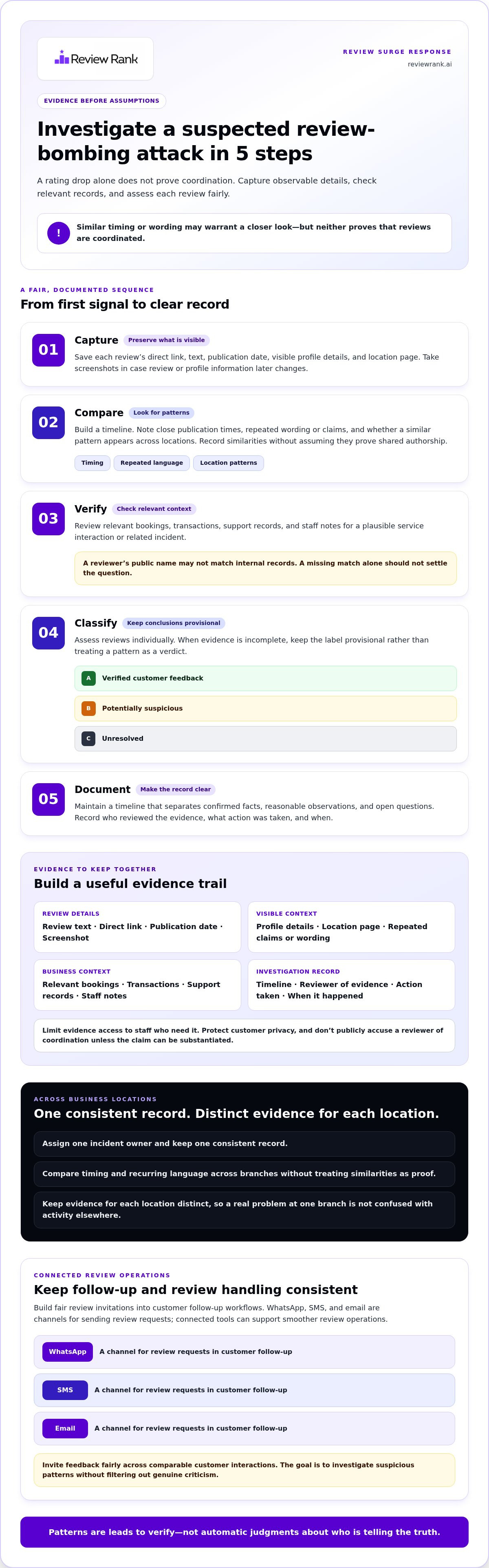
- 1. Capture. Save each review’s direct link, text, publication date, visible profile details, and the page or location where it appears. Take screenshots in case reviews or profile information later change.
- 2. Compare. Put the reviews on a timeline. Note repeated wording, close publication times, similar claims, and whether the same pattern appears across business locations. Record similarities without assuming they prove shared authorship.
- 3. Verify. Check relevant bookings, transactions, support records, and staff notes. Look for a plausible service interaction or related incident, while remembering that a reviewer’s public name may not match internal records.
- 4. Classify. Label each item as verified customer feedback, potentially suspicious, or unresolved. Keep the label provisional when evidence is incomplete, and assess reviews individually.
- 5. Document. Maintain a timeline that distinguishes confirmed facts, reasonable observations, and open questions. Record who reviewed the evidence, what action was taken, and when.
What evidence should a team document?
Keep the review itself and the context around it: text, visible profile information, publication date, direct link, screenshot, and location page. Add relevant service records and internal incident notes when they help verify what happened. Limit access to staff who need the information to investigate or respond. Don’t post private customer details publicly, and don’t accuse a reviewer of coordination unless you can substantiate the claim.
How can teams assess reviews across locations?
For multi-location businesses, assign one incident owner and keep one consistent record. Compare review data across branches, noting timing and recurring language without treating those similarities as proof. Keep evidence for each location distinct so a real problem at one branch doesn’t get confused with activity elsewhere.
The Google Local 3-Pack Leaderboard helps monitor local search positions. It tracks visibility, not reviewer identity or manipulation, so use it as a separate operational signal. A reliable process for protecting brand from review bombing depends on evidence, not assumptions. Review Rank Ai’s review monitoring tools support consistent review operations.
How to Respond, Report Suspicious Reviews, and Protect Customer Trust
A public reply and a platform report serve different purposes. Your reply shows customers that the business is listening. A report asks the platform to assess whether a review breaches its current policies. Keep both calm, factual, and separate. Reporting a review doesn’t guarantee its removal; moderation decisions belong to the platform.
What should a public response say?
Acknowledge the concern, respond to details you can address, and offer a suitable private channel to discuss account-specific matters. Don’t debate the reviewer’s motives or disclose information about a booking, purchase, appointment, or complaint. A measured reply can reassure future customers without turning the exchange into a public argument.
For example: “We’re sorry to hear about your experience. We’d like to understand what happened. Please contact our team privately so we can look into your concerns.” Adapt the wording to the review rather than pasting the same response everywhere. Consistent principles matter, but the reply should show that someone considered the specific feedback.
Don’t ask a customer to change or remove a review in exchange for a refund, replacement, or other remedy. Address the service issue on its own merits. That keeps the response focused on resolution, not on influencing what the customer says publicly.
When and how should a review be reported?
Report a review only when you can identify a specific, reasonable basis under the platform’s current policies. A low rating, disagreement with an opinion, or an unverified suspicion of coordination isn’t enough by itself. Review the platform’s reporting guidance, then use its designated reporting option, such as the review controls in a business account.
Make the report concise. Identify the review and explain which policy concern you believe applies, using relevant evidence rather than speculation. Keep a copy of the report, submission date, review link, and any platform response with the incident record. If the platform declines to act, don’t escalate public accusations. Continue monitoring, respond professionally where appropriate, and follow the platform’s reporting process.
Response checklist:
- Acknowledge the concern and address details that are appropriate to discuss publicly.
- Protect private customer information and move account-specific conversations to a private channel.
- Report only a specific suspected policy violation, and preserve the report record.
- Let the platform decide whether its policies were breached; don’t promise or imply removal.
Protecting brand from review bombing means staying credible under pressure. Calm, tailored replies and evidence-based reports show customers that your team takes feedback seriously, while leaving moderation decisions to the platform.
How to Reduce Future Risk Without Filtering Out Genuine Feedback
A resilient review operation isn’t built by hiding criticism. It comes from making feedback easier to monitor, route, and act on, while giving customers a fair opportunity to share their experiences. A steady flow of authentic reviews can provide broader context over time, but it can’t guarantee protection from an attack, a particular rating, or the removal of negative reviews.
How can review requests support a healthier feedback baseline?
Use a consistent process to invite feedback across comparable customer interactions. Apply the same criteria whether the experience seems positive, neutral, or disappointing. Selecting only customers you expect to leave praise risks distorting the picture and undermining trust.
Review Rank Ai automates review invitations through WhatsApp, SMS, and email. These channels make it easier to build requests into regular customer follow-up. Set a consistent approach to eligibility and timing, then use it across comparable experiences. A fair invitation process makes room for praise and criticism alike.
What should a review-monitoring routine include?
Make the process repeatable. Assign an owner for checking review channels, set a review cadence that fits your business, and define who handles replies and who investigates unusual activity. Keep a shared record of reviews, actions, and unresolved issues so separate locations or teams don’t work from conflicting information.
- Route feedback clearly. Send service concerns to the team best placed to investigate, and escalate suspicious patterns for closer review.
- Track themes separately. Record recurring issues such as appointment communication or delivery delays apart from suspected coordinated activity. Repeated criticism may point to an operational fix.
- Use filtering responsibly. Review filtering can help organize negative feedback for attention. It shouldn’t conceal genuine criticism, block access to public reviews, or steer only satisfied customers toward review channels.
This distinction matters for protecting brand from review bombing: internal tools should help staff prioritize and understand feedback, not decide that a negative opinion should disappear. Review Rank Ai’s negative feedback filtering supports reputation management, while genuine public criticism still deserves a fair response.
Build a more consistent review workflow with automated reputation management software.
How Review Management Integrations Support a Faster, More Consistent Response
A connected review workflow links customer interactions with invitations, review monitoring, and response tasks. The goal is to make handoffs clearer and give teams a consistent process, not to automate judgments about reviewer intent. Review Rank Ai sends review invitations through WhatsApp, SMS, and email. Its integrations connect review management with the tools businesses use to manage customer interactions and follow-up.
How do connected review workflows fit together?
A customer touchpoint, such as a completed appointment or purchase, can prompt a review invitation through an appropriate channel. New feedback then becomes part of the team’s monitoring routine, where staff can identify recurring service issues and handle response tasks consistently. Connecting these steps helps teams make review requests and follow-up part of their everyday customer workflow.
AI-generated response drafts can help teams work faster and keep a consistent tone. Staff should review sensitive replies before publication, especially when a review involves a complaint, private customer details, or a suspected policy issue. For more guidance on drafting replies, explore Review Rank Ai’s AI review response generators.
| Channel | Potential operational fit | Workflow consideration |
|---|---|---|
| A review request within a customer communication workflow that already uses WhatsApp. | Include invitations in customer follow-up and assign someone to monitor replies or follow-up tasks. | |
| SMS | A concise invitation through a text-message workflow. | Use consistent eligibility criteria and include review activity in the team’s monitoring routine. |
| A request as part of an existing customer follow-up process. | Make invitations part of follow-up and assign responsibility for monitoring review activity. |
How can a business choose a practical response workflow?
Start with the channels customers already use and the team’s capacity to handle replies. A single-location business may assign one owner to invitations and responses. A multi-location group may need clear branch-level responsibilities and a shared escalation process. These choices help teams connect review activity with the day-to-day customer workflow.
For teams protecting brand from review bombing, automation can organize invitations and response work, but it can’t verify coordination by itself. Keep human judgment in the loop and use the Review Rank Ai platform to support a consistent review workflow.
Build a Review Process That Earns Trust
Protecting brand from review bombing means staying grounded in evidence. Look for patterns without mistaking a rating drop for proof, document what you can verify, and treat each genuine complaint with care. A steady monitoring routine helps your team respond consistently while keeping real customer feedback in view.
Automation can support that process. Review invitations can be sent through WhatsApp, SMS, and email, while AI-generated responses help teams maintain a consistent workflow. The Google Local 3-Pack Leaderboard tracks local search positions, giving you another signal to monitor alongside customer feedback.
Put a repeatable system behind your reputation operations. Explore automated review management and give your team practical tools to keep feedback organized and responses moving. With clear evidence, fair invitations, and thoughtful replies, you can meet a review surge with confidence and keep building customer trust.
Frequently Asked Questions
What is review bombing?
Review bombing is a sudden, unusual cluster of negative reviews that may indicate coordinated activity. It differs from ordinary criticism when there are signs reviewers may not be describing their own customer experiences, but timing or low ratings alone don’t prove coordination. Several unhappy customers may post close together after a genuine service issue. Assess the content and context before deciding how to respond or whether to report reviews.
How can I tell if my business is being review bombed?
Look for multiple signals, such as reviews arriving unusually close together, repeated or generic wording, limited visible account history, or claims that lack clear context about a customer experience. Compare these details with relevant service records and known incidents. Treat each signal as a reason to investigate, not proof. Protecting brand from review bombing starts with a documented pattern, not a rating drop or assumption about reviewer intent.
Can I get fake or coordinated reviews removed?
A review platform may remove content it determines violates its current policies, but a report doesn’t guarantee removal. Use the platform’s reporting process when you have a specific, reasonable basis for believing a review breaches its rules. Include concise, relevant evidence and keep a record of your submission. If the platform leaves the review up, continue to respond professionally and avoid making public claims you can’t substantiate.
What should I do first when negative reviews arrive suddenly?
Preserve the evidence before drawing conclusions. Save review links, screenshots, publication dates, visible profile details, and the locations where reviews appear. Then compare the timing and language, and check relevant bookings, transactions, support records, or staff notes for possible context. Keep confirmed facts separate from observations and unanswered questions. Assign one person to coordinate the review so the team works from a consistent record.
Should I respond publicly to suspected review-bombing reviews?
Usually, a short, calm reply can show readers that your business takes feedback seriously. Acknowledge the concern without arguing about motives, disclosing private information, or accusing the reviewer of coordinating an attack. Invite them to continue the conversation through an appropriate private channel. Report a suspected policy violation separately through the platform. Tailor each response to the review rather than posting an identical reply across every comment.
Can review filtering protect my brand from review bombing?
Review filtering can help teams organize feedback and identify items that may need internal attention, but it shouldn’t conceal genuine criticism or manipulate which reviews reach the public. Use it to organize concerns for review, not to assume a negative comment is false. Keep customer feedback accessible to the people responsible for investigating it, and respond fairly. Filtering supports a workflow; it can’t establish whether reviews are coordinated.
How can review requests through WhatsApp, SMS, and email help?
Review requests through WhatsApp, SMS, and email can make it easier to invite feedback as part of a consistent customer follow-up process. Use the same eligibility criteria across comparable interactions rather than selecting only customers likely to leave positive reviews. A steady invitation routine can help gather authentic feedback over time, but it can’t prevent review attacks, guarantee a rating, or ensure negative reviews are removed.