
Online Business Reputation: How to Build Trust and Stay Visible
What shapes a customer’s decision before they ever speak to your team? Your online business reputation is built from the signals they find across reviews, search results, and other customer touchpoints. When feedback is scattered, negative comments can demand attention while positive reviews go unused.
You already know trust matters. The challenge is managing it consistently without turning review requests, responses, and visibility checks into another time-consuming task. A stronger approach treats reputation as an operating system: listen, respond, learn, and improve.
This article explains the signals that shape customer perception, then shows how to build a practical process for collecting feedback, responding thoughtfully, and tracking visibility against business goals. You’ll also see how automated invitations through WhatsApp, SMS, and email, AI-generated responses, review repurposing, and local ranking tracking can support that process, along with where integrations fit into a connected workflow. The goal is clear: earn trust with authentic feedback and make reputation work measurable.
Key Takeaways
- Map the search, comparison, and decision signals customers encounter to see what shapes your online business reputation before they choose you.
- Separate what your business can control, such as service quality and responses, from public opinions you can’t dictate.
- Track review volume and recency, response coverage, recurring feedback themes, listing accuracy, and local visibility to connect reputation metrics to business questions.
- Build a repeatable feedback workflow, from inviting customers to reviewing feedback and acting on patterns; invitations can be sent through WhatsApp, SMS, and email.
- See how automated invitations, AI-generated responses, negative-feedback filtering, review repurposing, and 3-Pack tracking can support a connected reputation process.
What Shapes an Online Business Reputation Before Customers Choose You?
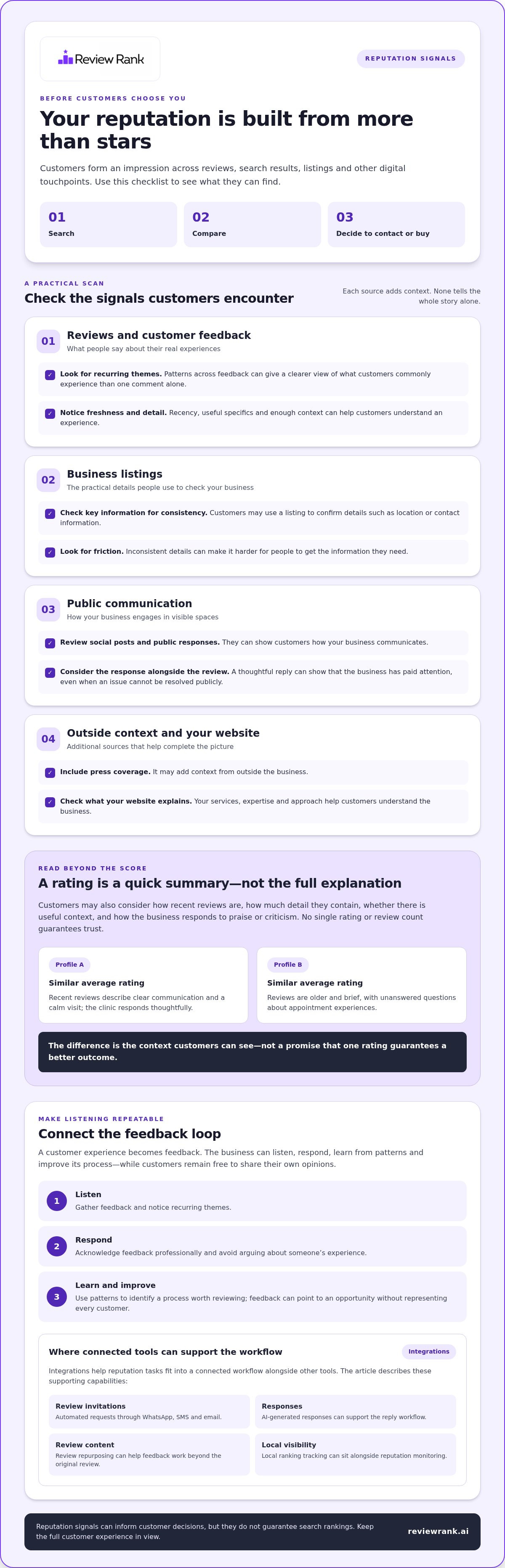
A customer searches, compares a few options, checks whether each business seems trustworthy, then decides whether to make contact or buy. At every step, they encounter information that can build confidence, raise questions, or send them elsewhere. Your online business reputation takes shape through these signals, not through a star rating alone.
Online business reputation is the combined public perception of a business formed through digital customer touchpoints. It reflects what people say, what the business communicates, and how consistently its information appears online. The broader concept of Reputation management helps explain why reputation involves more than responding to reviews. It means paying attention to the different sources that shape an impression.
Which online signals shape a business reputation?
Reviews give prospective customers accounts of real experiences. Their details can reveal what people value, where expectations are being met, and which issues recur. A single comment offers one perspective; patterns across feedback can provide a clearer view of what customers commonly encounter.
Other signals fill in the picture. Business listings help people check practical details, such as a location or contact information, and inconsistencies can create friction. Social posts and public responses show how a business communicates. Press coverage may add outside context, while website content explains the business’s services, expertise, and approach. Customers can encounter these sources across review platforms, search results, social channels, listings, and the company website. Together, they shape the impression; none tells the whole story on its own.
Why can a high rating still leave customers uncertain?
A rating is a quick summary, not a full explanation. Customers may also consider how recent the reviews are, how much useful detail they contain, whether there’s enough context to understand the experience, and how the business responds to praise or criticism. No single rating or review count guarantees trust. The details matter.
Hypothetical example: Imagine two clinics with similar average ratings. One has recent reviews describing clear communication and a calm visit, along with thoughtful responses from the clinic. The other has older, brief reviews and unanswered questions about appointment experiences. A prospective patient may find the first profile more reassuring, not because its rating is higher, but because the information offers fresher context and shows how the business engages.
That distinction gives businesses a practical starting point: assess the full set of signals customers can see, then look for gaps between the experience you intend to deliver and the impression your online touchpoints create.
How Does Online Business Reputation Form Across the Customer Journey?
An experience becomes feedback. Feedback gets a response, or goes unanswered. Future customers then interpret both the original comment and the business’s reaction. That cycle is how an online business reputation develops over time, one customer interaction and public signal at a time.
Consider a restaurant where several guests mention confusion about how to book a table. That pattern doesn’t prove every guest has the same experience, but it can point the team toward a process worth reviewing. If the restaurant clarifies booking information and customers later describe an easier process, the feedback loop has supported a practical improvement. The reviews remain customers’ own opinions; the business controls how it listens and responds, not what people choose to say.
How do reviews and responses influence customer perception?
Specific feedback helps prospective customers judge whether a business fits their needs. A hotel review describing room accessibility or a clinic review mentioning appointment communication offers more context than a bare rating. Reviews can also reflect individual expectations, so look for recurring themes rather than treating one comment as a complete verdict.
Responses add another visible signal. A timely, relevant reply can show that the business has paid attention, even when it can’t resolve every concern publicly. Keep the tone professional, acknowledge the issue where appropriate, and avoid arguing about someone’s experience. For healthcare and other sensitive settings, protect personal information and move individual matters to an appropriate private channel.
How does reputation connect with local visibility?
Reviews and accurate business information can help people assess and find a local business, but visibility depends on more than review activity. Search platforms use their own systems and may change how local results appear. Reputation signals can inform customer decisions, but they don’t guarantee search rankings. Check the relevant platform’s current documentation before describing any signal as a ranking factor.
Ratings also need context. MIT Sloan Management Review’s The Problem With Online Ratings discusses social influence bias, a reason to avoid treating a score as a complete or objective account. Pair reputation monitoring with attention to customer feedback patterns and listing accuracy. For a practical overview of online reputation tools and workflows, explore how Review Rank Ai brings review invitations, responses, and local visibility tracking into a connected process.
How Can You Measure Reputation Without Chasing Vanity Metrics?
A high score looks good on a dashboard. It doesn’t tell you what to fix, whether feedback is current, or how consistently your team handles it. Measure your online business reputation with metrics tied to decisions, then compare them against your own baseline instead of chasing someone else’s benchmark.
Start by recording the same measures for each reporting period. Keep the definitions and time windows consistent. Separate activity, such as responses sent, from outcomes, such as changes in feedback themes. Activity shows whether a process happened. Outcomes help you assess what customers are saying, without assuming one caused the other.
Which reputation metrics should a business track?
Use each measure to answer a practical question. No single metric gives the complete picture.
| Metric | Business question it helps answer |
|---|---|
| Review volume and recency | Are customers sharing feedback over time, and does it reflect recent experiences? |
| Rating trend | Is the overall score moving, and should we examine the individual reviews behind the change? |
| Response coverage | Are we responding consistently, or are some feedback types or periods being missed? |
| Recurring feedback themes | Which parts of the customer experience appear repeatedly in comments and may merit review? |
| Listing accuracy | Do customers see consistent business information across key listings? |
| Location visibility | How does local search visibility vary by location and reporting period? |
Ratings can help flag a shift, but averages can hide very different experiences. Read the comments behind the score and note recurring topics, such as appointment communication or order accuracy. Harvard Business School’s work on designing for trust and reputation offers useful context on how reputation systems support trust in online interactions. Treat metrics as prompts for investigation, not proof of cause.
A metric earns its place when it points to a specific action. If response coverage is low, review the response workflow. If customers repeatedly mention unclear instructions, investigate where those instructions appear and whether they’re easy to follow.
How should multi-location businesses compare results?
Use the same metric definitions and equivalent reporting periods for every branch. Then inspect location-level patterns before drawing group-wide conclusions. A recurring issue at one clinic may call for a local process review; a similar theme across several branches may warrant a broader look. Compare like with like, and use the findings to decide what to investigate next.
How Do Review Workflows and Integrations Make Reputation Management Consistent?
A repeatable workflow turns feedback into a useful business habit. It helps teams request reviews consistently, respond with care, and spot patterns without trying to control what customers say. Integrations can help connect reputation tasks with other business tools, but the exact workflow depends on the connection. Start with a process your team can follow, then use documented integrations where they fit.
- Identify an eligible customer moment. Choose a suitable point after an interaction, such as a completed appointment, stay, or service.
- Invite feedback. Send a clear, neutral request that leaves the customer free to share an honest opinion.
- Monitor responses. Keep track of new public reviews and feedback that needs attention.
- Learn. Look for recurring themes, not just isolated comments or changes in an average rating.
- Improve. Assign a practical next step, then check later feedback for useful context on the experience.
How can WhatsApp, SMS, and email fit into review invitations?
Review Rank Ai can send invitations through WhatsApp, SMS, and email. Choose a channel that fits your customer communication workflow and the moment you’re asking for feedback. Keep the message straightforward and neutral, inviting customers to share their experience without steering them toward a particular rating or opinion. The goal is a consistent, respectful request process, not a scripted outcome.
How should reputation tools work with other business tools?
Think through an integration in three parts: trigger, information, action. Identify what event starts the workflow, what information the connection uses or passes, and what happens next. The available trigger, data, and action vary by integration, so don’t assume every tool works the same way. Review the Review Rank Ai integrations page for the connections and capabilities described there before building a process around them.
AI-generated review responses can support faster feedback workflows, while still requiring staff oversight for accuracy, context, tone, and privacy. For more about using AI to assist with replies, explore AI review response tools. Negative-feedback filtering supports feedback workflows; it doesn’t mean removing, hiding, or preventing public criticism.
Connect only the steps that serve a clear purpose, assign responsibility for monitoring the process, and use customer feedback to guide improvements. Explore Review Rank Ai’s reputation tools to support a more consistent review workflow.
How Can Review Rank Ai Help Turn Online Business Reputation Into Action?
Understanding the signals is the first step. The next is making the routine work repeatable. Review Rank Ai brings together tools that can support review invitations, response workflows, feedback review, and local visibility tracking. The aim is consistency and clearer insight, not manufactured opinions or guaranteed ratings and rankings.
Which reputation tasks can Review Rank Ai support?
Automated review invitations help businesses make feedback requests part of their customer process. Review Rank Ai can send invitations through WhatsApp, SMS, and email, giving teams options for fitting requests into their communication workflow. The invitation should remain neutral and let each customer share an honest experience.
AI-generated review responses can help staff move through replies more efficiently. They’re a starting point, not a substitute for human judgment: review each response for accuracy, context, tone, and privacy before using it. Negative-feedback filtering supports the process of organizing or directing feedback for attention. It doesn’t erase public criticism or prevent customers from sharing it.
Reviews can also be repurposed automatically for business websites and social media, extending the use of customer feedback across those channels. The Google Local 3-Pack Leaderboard tracks local search ranking positions, helping businesses monitor visibility over time. Neither tracking rankings nor managing reviews guarantees a particular position in search results.
What should a business do next to strengthen its reputation?
Start with a baseline. Record current review activity, response practices, recurring feedback themes, and local visibility. Then pick one friction point. A single-location service business might assign responsibility for reviewing new feedback; a multi-location retailer might compare recurring themes across branches using the same definitions and reporting periods.
Give the chosen workflow a clear owner before adding automation. That person can monitor whether invitations and responses are handled consistently, identify feedback that needs attention, and pass recurring service issues to the right team. Automation can reduce repetitive effort, but people still need to interpret feedback and improve the customer experience. That’s how tools support a stronger online business reputation without promising outcomes no workflow can control.
Integrations can help connect reputation tasks with other business tools, but the useful setup depends on what each connection actually supports. Map the trigger, the information shared, and the resulting action. Use the integrations documentation to understand the named connections and workflows, and avoid assuming that every tool passes the same data or triggers the same task.
Build a more consistent reputation workflow with Review Rank Ai.
Make Reputation a Consistent Part of Your Growth Plan
Your online business reputation is shaped by more than a star rating. Customers weigh recent feedback, business responses, and consistent information across the places they discover you. A clear baseline helps you track those signals without confusing activity, such as replies sent, with outcomes, such as recurring customer themes.
The next step is a workflow your team can sustain: invite feedback, review what customers share, respond thoughtfully, and act on patterns. Review Rank Ai supports this process with review invitations through WhatsApp, SMS, and email, AI-generated responses, and a Google Local 3-Pack Leaderboard for monitoring local ranking positions. These tools can make routine tasks more consistent, while your team brings the judgment and service improvements that build genuine trust.
Explore Review Rank Ai and see how review workflows can fit into your business. Start with one practical improvement, keep learning from customer feedback, and build momentum from there.
Frequently Asked Questions
What is an online business reputation?
An online business reputation is the public perception of a business formed through digital customer touchpoints. It can include reviews, business listings, social posts, search results, website content, and the business’s public responses. Customers interpret these signals together, so a star rating alone can’t tell the whole story. Review detail, recency, consistency, and the way a business engages with feedback all contribute to the impression.
How can I improve my business reputation online?
Improve your business reputation online by making feedback part of a consistent process. Invite customers to share honest opinions, monitor reviews, respond clearly and professionally, and look for recurring themes that may point to service improvements. Keep your business information consistent across important listings, too. Track a baseline of reviews, responses, and feedback patterns so you can assess progress using comparable periods instead of chasing a one-time rating change.
Can a business control its online reputation?
A business can influence its online reputation, but it can’t control public opinion. You control actions such as the customer experience, how and when you invite feedback, the accuracy of business information, and how you respond. Customers decide what they share and how they feel. Focus on listening, responding respectfully, and addressing patterns in feedback rather than trying to dictate reviews or remove criticism simply because it’s negative.
Do online reviews affect local search visibility?
Reviews can help customers assess a local business, and review signals may relate to local discovery, but they don’t guarantee a particular search position. Local results can depend on multiple factors and vary by platform and location. Treat visibility tracking as a way to observe changes, not proof that review activity caused them. Check current search-platform documentation before making claims about specific ranking factors.
How should a business respond to a negative online review?
Respond calmly, acknowledge the concern, and keep the reply relevant to what the reviewer raised. Avoid arguing, making assumptions, or sharing personal or sensitive details in public. If resolving the issue requires specific information, invite the reviewer to continue through an appropriate private channel. Review the feedback internally as well. A thoughtful public response can show future customers that the business takes concerns seriously, even when opinions differ.
Can businesses send review requests through WhatsApp, SMS, and email?
Yes. Review Rank Ai can send review invitations through WhatsApp, SMS, and email. A business can choose a suitable channel for its customer communication workflow and send a clear, neutral invitation after an appropriate customer interaction. The request should leave people free to share honest feedback, rather than steering them toward a particular rating or outcome. Consistency helps make review invitations a repeatable part of the customer process.
How do integrations help with online reputation management?
Integrations can connect reputation tasks with other business tools, helping teams coordinate steps such as triggering an invitation or organizing information for follow-up. The exact workflow depends on the supported connection and the data it handles. Before relying on an integration, understand its trigger, information exchanged, and resulting action. That clarity helps teams build a connected process without assuming every tool works the same way.