
How to Stop Worrying About Bad Reviews: 2026 Guide
One bad review can feel louder than a hundred good days. If you’re searching for how to stop worrying about bad reviews, you’re probably not looking for a way to ignore criticism. You want to know whether it points to a real problem, what to say in response, and how to stop replaying it after you’ve closed the review page.
That reaction is understandable. A negative comment can raise doubts about what prospective customers will think, especially when you’re unsure whether a reply will help or make things worse. You can’t control every review, but you can control the process around it.
This guide will help you assess feedback calmly, separate useful details from subjective or unsupported claims, and respond with a clear, consistent approach. You’ll also learn how to set boundaries around checking reviews and turn credible criticism into practical follow-up, without letting one person’s opinion define your business. When review tasks become repetitive, tools such as automated review invitations and AI-generated responses can support your workflow without replacing your judgment.
Key Takeaways
- Learn how to stop worrying about bad reviews by separating the sting of criticism from evidence about your business.
- Use a simple review-assessment sequence to check what’s verifiable and decide whether action is needed.
- Build a calm, concise response that acknowledges the concern and focuses on facts and useful next steps.
- Set a review-checking routine and clear ownership to reduce constant monitoring and uncertainty.
- Consider how automated review invitations and AI-generated responses can support a consistent review workflow.
Why bad reviews feel so personal-and what they actually tell you
A negative review can sting, especially when you care about the work behind your business. It may raise immediate questions: Will potential customers believe this? Did the team miss something? Is this one comment evidence of a bigger problem? Those questions deserve a measured look, not an automatic assumption that your business is in crisis.
Here, review anxiety means worry about public feedback and what you think it could mean for your business. It isn’t a diagnosis. It’s a common response to criticism that feels visible, uncertain, and difficult to control. Understanding negativity bias, the tendency for negative information to draw more attention than equally positive information, can help explain why one critical comment may occupy your thoughts even when other feedback is more reassuring.
A review is one customer’s account of one experience, not a representative assessment of your whole business. Treat it as information to examine, not a verdict to accept without question.
Why one negative review can dominate your attention
Public criticism can feel unsettling because you may not know what the reviewer expected, what happened before the interaction, or how other readers will interpret the comment. You might check the page again, hoping for a reply, a new review, or some sign that the situation has changed. But if nothing new has appeared, refreshing the page adds no information. It can keep the concern active instead of helping you decide what to do.
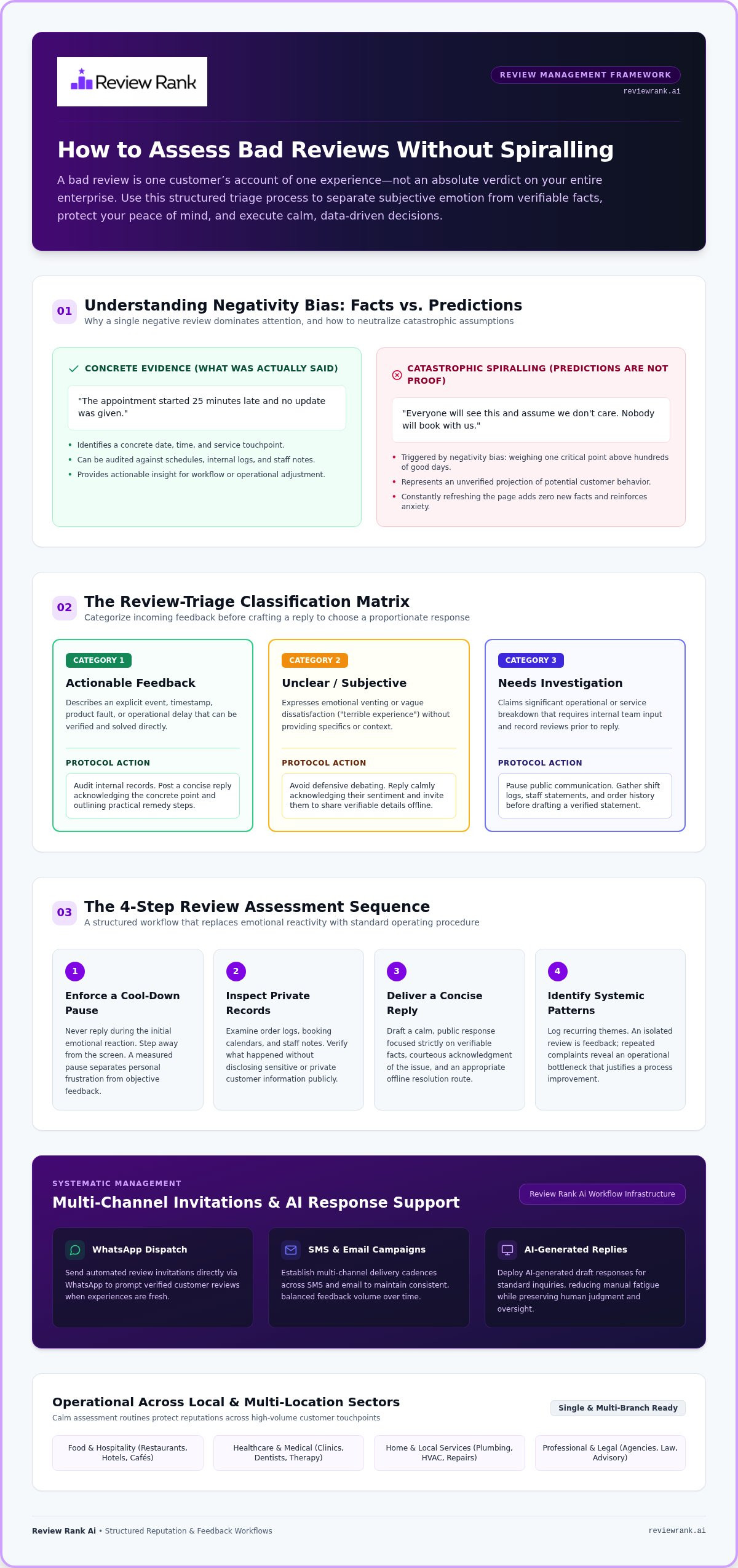
That’s why learning how to stop worrying about bad reviews starts with separating the review itself from the questions your mind attaches to it. Write down what the customer actually said, then distinguish it from predictions such as “everyone will think this happens” or “no one will choose us.” Predictions aren’t proof.
What a review can-and cannot-tell you
A review can describe a specific experience, point to a possible service issue, or reveal a mismatch in expectations. It can also reflect a subjective preference or contain claims too unclear to verify. For example, “the appointment started late” gives you something concrete to check against schedules and staff notes. “This business doesn’t care about customers” expresses a judgment, but doesn’t by itself explain what happened.
Before drawing a broad conclusion, look for context. Check relevant records, ask the people involved, and see whether other reviews describe a similar issue. One comment may justify a follow-up. A repeated, verifiable pattern may support a process change. Neither requires you to assume every future customer will have the same experience.
How to stop worrying about bad reviews: assess the feedback without spiralling
A repeatable check turns a review from an open-ended worry into a decision. Don’t draft a reply while you’re angry or keep refreshing the page for certainty. Pause, gather what can be verified, then choose a proportionate next step.
Actionable feedback is specific, contextual information you can check against what happened. A comment such as “my appointment started late” gives you a detail to investigate. An insult or broad claim such as “this place is always terrible” may express frustration, but it doesn’t establish a specific service failure.
A quick review-triage checklist
Start with the review itself, not the conclusions you fear others will draw. Ask whether it identifies a concrete interaction, date, product, or service issue. Then check relevant records privately, such as schedules, order details, or staff notes, where appropriate. Don’t reveal personal or sensitive customer information in a public response.
Classify the comment before deciding what to do:
- Actionable: It describes a specific issue you can verify or address.
- Unclear: It lacks enough detail to identify what happened.
- Needs investigation: It raises a concern that requires input from staff or a review of internal records.
If similar feedback appears more than once, record the theme and check it against operational details. A pattern is more useful evidence for a process change than one upsetting comment on its own.
When to respond, and when to pause
Give yourself time to cool down before writing. A brief pause helps you separate the customer’s reported experience from your first emotional reaction. Then decide whether a public reply would clarify what you can confirm, acknowledge the concern, or offer a suitable next step. Harvard Business Review’s guidance on a practical plan for moving forward can also help you process criticism constructively.
Set a regular time to review feedback instead of checking throughout the day. If a comment raises a serious safety concern or involves private information, take it to the appropriate internal contact rather than trying to resolve it in a public thread. If worry about reviews persistently disrupts daily life, consider speaking with a qualified professional.
A simple routine can make follow-up more consistent. If you’re exploring tools to support review workflows, Review Rank Ai offers automated review invitations and AI-generated review responses.
Responding to Bad Reviews Calmly and Constructively
A public reply isn’t a courtroom argument or a chance to win over the reviewer at any cost. It’s an opportunity to show other readers that you take concerns seriously and handle them with care. A dependable response stays brief, sticks to what you can confirm, and moves detailed discussion to a suitable private channel.
A simple structure for a professional reply
Build your reply in four parts: acknowledge the concern, address only confirmed facts, explain what you’ll check or do next, and invite the reviewer to continue privately if more detail is needed. Tailor the opening to the issue instead of pasting the same generic apology under every review.
For example: “Thanks for sharing this. I’m sorry the appointment didn’t meet your expectations. We’ll review what happened with our team. Please contact us privately with the appointment details so we can look into it.” Adjust the wording to fit the facts. Don’t disclose customer information, promise an outcome you can’t guarantee, pressure someone to change their review, or argue point by point in public. Acknowledge the person’s experience without claiming facts you haven’t checked.
How to learn from criticism without overreacting
One comment may call for a thoughtful reply; recurring, specific feedback may point to an operational issue worth addressing. Look for a theme across reviews, then check whether internal records or staff accounts support it. If the concern is substantiated, assign an owner, agree on an action, and set a follow-up check. That turns criticism into a defined task instead of an ongoing source of doubt.
A respectful response demonstrates attention, but it can’t guarantee that criticism will disappear or that a reviewer will change their view. Its value is in communicating clearly and showing that the concern has been heard.
If you’re deciding how to stop worrying about bad reviews, focus on making the reply useful, not perfect. Read it once for accuracy and tone, remove defensive language, and step away after posting. For more on creating a consistent response workflow, see this AI review response guidance. AI-generated responses can provide a starting point, but review every draft and correct it to reflect the specific situation before publishing.
How review routines and integrations can reduce uncertainty
Constantly checking review pages can make every new comment feel urgent. A defined routine gives feedback a place in your workday without letting it take over. Choose a review-checking cadence that fits your business, then assign one person to coordinate triage, investigation, response drafting, and escalation. Other team members can provide context when needed, but one clear owner helps prevent comments from being missed or handled inconsistently.
Build a routine that limits reactive checking
During each review check, look beyond the star rating. Record the specific theme, whether it can be verified, who owns any follow-up, and what action was taken. For example, if customers repeatedly mention unclear appointment instructions, check the current process and assign someone to review it. This creates a useful record of patterns and actions, rather than a running tally of comments to worry about.
Keep the routine proportionate to your business needs. The right cadence depends on how often customers leave feedback and how your team can respond. The aim is consistent attention, not constant monitoring.
Where automation can help, and where it cannot
Automated review invitations can make it easier to invite customers consistently and transparently. Requests should not pressure people to leave a review or target only customers expected to leave positive feedback. AI-generated review responses can support the drafting workflow, but a person should check each response for accuracy, context, tone, and privacy before it’s published.
Integrations can connect review processes with other tools, but the exact partners and workflows should be confirmed before you rely on them. Check the Review Rank Ai integrations page for current details, and verify that a listed connection fits your workflow. Don’t assume a particular tool, data flow, or automated action is supported unless it’s confirmed.
Automation can reduce repetitive invitation and response-drafting work. It can’t guarantee positive reviews, eliminate criticism, or replace service improvements when feedback points to a real issue. Use it to support a process your team owns, not to avoid listening or make decisions without review.
If you’re working out how to stop worrying about bad reviews, make the next check predictable and give it a clear owner. Explore Review Rank Ai’s review workflow tools to see whether automated invitations and AI-generated responses could support your routine.
A practical plan for moving forward after a bad review
The goal isn’t to make criticism disappear. It’s to decide what deserves attention, take a useful next step, and return to the work in front of you. Try this reset once you can assess the comment without replying in the heat of the moment.
A five-step reset after criticism
- Pause. Give yourself time before drafting a public response.
- Separate facts from fears. Write down the reviewer’s specific concern, then note any interpretations you’re adding, such as “this will happen to every customer.”
- Check what you can. Review relevant records and ask the people involved. Keep private customer details out of your public reply.
- Choose a proportionate action. Respond if a calm, factual reply would help; investigate unclear concerns; and make a process change only when the available evidence supports it.
- Record and disengage. Note any action, who owns it, and when it should be checked. Then return to your planned review routine instead of refreshing the page.
One emotional reaction isn’t enough to prove that a process is broken. Look for a specific issue you can verify, or a recurring theme in feedback, and compare it with what your team can confirm. If the evidence supports a change, document what you’ll adjust and check whether the change addresses the problem. If it doesn’t, a measured reply may be all that’s needed.
Keep review invitations consistent and transparent. Invite customers to share honest feedback through your chosen process, without pressuring them or asking only people you expect to be satisfied. Over time, recording both recurring concerns and improvements made gives your team a clearer basis for decisions than reacting to each comment in isolation.
When a review-management workflow may be useful
For a single-location business, one person may be able to manage review checks and follow-up. Multi-location and high-volume businesses may need clearer ownership so that feedback reaches the right team and responses follow a consistent process. A defined workflow can help track who investigates, who responds, and what happens next.
If you’re comparing approaches, read this guide to automated reputation management. Software can support routine tasks, such as sending review invitations, but it can’t erase negative reviews or replace service improvements. If that kind of workflow support fits your needs, explore Review Rank Ai.
Build a steadier way to handle feedback
Learning how to stop worrying about bad reviews doesn’t mean ignoring criticism. It means treating each comment as information to assess, responding calmly when a reply is useful, and making changes when evidence points to a real issue. A consistent review routine can help you do that without letting one customer’s account define your whole business.
Review Rank Ai offers tools that can support this process, including automated review invitations, AI-generated review responses, a Google Local 3-Pack Leaderboard, negative feedback filtering, and automatic repurposing of reviews for social media and websites. Check current feature and integration details to see what fits your needs. These tools can help organize review tasks, but your judgment and service improvements remain essential.
Explore Review Rank Ai’s review-management platform to see whether its automated invitations, AI-generated responses, and local ranking tracking could support a more consistent approach to feedback. A bad review may deserve your attention, but it doesn’t have to control your day. Assess it, take the next useful step, and move forward with confidence.
Frequently Asked Questions
How do I stop worrying about a bad review?
Start by separating what the reviewer actually reported from what you fear it means. Check specific details against relevant records, decide whether a response or follow-up is useful, then return to your planned review routine. The goal of how to stop worrying about bad reviews isn’t to dismiss criticism. It’s to assess it proportionately, act on anything verifiable, and avoid treating one customer’s account as a verdict on your whole business.
Should I respond to every negative review?
Consider responding when a calm, factual reply can acknowledge the concern or clarify what you’ll do next. If the review is unclear, take time to investigate before answering. Keep public replies respectful and brief, and move discussions involving personal or sensitive details to an appropriate private channel. You don’t need to argue with insults or speculate about the reviewer. A consistent response policy can help your team make these decisions more steadily.
Can a bad review ruin my business?
A single review doesn’t automatically determine how customers see your business, but it can raise a concern worth checking. Look at the specific claim, relevant operational details, and whether similar feedback appears elsewhere before deciding it signals a wider issue. Respond professionally if a reply would be useful, and address substantiated problems. Avoid assuming either that the review will cause lasting harm or that it can be ignored without review.
How do I stop checking my reviews all the time?
Choose a regular review-checking schedule that fits your business, and assign one person to monitor feedback and coordinate follow-up. Outside that routine, resist refreshing review pages unless there’s a specific reason to check. Keep a record of recurring themes and actions, not just ratings. If repeated checking continues to disrupt daily life, consider talking with a qualified professional for support.
What should I say when replying to a bad review?
Acknowledge the concern, address only what you can confirm, explain any next step, and offer a suitable private way to share details. For example: “Thanks for letting us know. I’m sorry the visit didn’t meet your expectations. We’ll look into what happened. Please contact us privately with more details.” Adjust the wording to fit the review. Don’t disclose customer information, make promises you can’t keep, or pressure the reviewer to change their feedback.
Can review-management software stop negative reviews?
No. Review-management software can’t guarantee positive feedback or prevent every customer from posting criticism. It can support parts of the workflow, such as sending review invitations or preparing AI-generated response drafts for human review. Review Rank Ai offers automated review invitations, AI-generated review responses, and a Google Local 3-Pack Leaderboard. Check current feature and integration details, and treat software as operational support, not a replacement for investigating valid concerns or improving service.
Is it okay to ask customers for reviews by text, email, or WhatsApp?
You can invite customers to share honest feedback through channels such as text, email, or WhatsApp. Keep requests clear and neutral, and don’t pressure customers or selectively ask only those likely to leave positive reviews. Apply the same invitation approach consistently, and check the review platform’s current policies before setting up a request workflow. If you use software to automate invitations, confirm which channels it supports before relying on a particular setup.