
How to Build Customer Trust With Reviews Customers Trust
A perfect star score isn’t what makes reviews trustworthy. To learn how to build customer trust with online reviews, show honest feedback from real customer experiences, including criticism, and respond professionally. Then act on recurring concerns so customers can see their feedback matters.
It makes sense to look for strong ratings before choosing a business. But a polished profile without specific details or visible responses can leave important questions unanswered. Clear comments, a range of opinions, and thoughtful replies help prospective customers understand what to expect.
This guide explains what makes a review credible, when and where to invite feedback, and how to respond in ways that build confidence. You’ll also learn how to spot patterns in reviews and use those insights to improve customer experiences. The goal isn’t to make every review positive. It’s to make your business more transparent, responsive, and worthy of trust.
Key Takeaways
- Respond to positive and negative feedback with care. A calm, specific reply shows customers that their experience matters.
- Build credibility with detailed, balanced reviews, not just a high star rating. Let readers see how your business handles criticism.
- Ask for feedback soon after a meaningful customer interaction, and make leaving a review straightforward.
- Choose review platforms that match where your customers look for businesses and services like yours.
- Look for recurring feedback and use it to improve the customer experience, then make it easy to request and manage reviews consistently.
1. Responding professionally to positive and negative feedback
Thank customers for positive reviews and refer to a specific detail, such as helpful staff or a smooth delivery. For negative feedback, acknowledge the concern, take responsibility where appropriate, and explain a practical next step without arguing publicly.
To assess whether review management builds trust and supports sales, track response coverage, review themes, customer sentiment, and business outcomes over time. Compare changes in inquiries, conversions, repeat purchases, and cancellations with the feedback and responses customers can see.
Speed and consistency matter. BrightLocal found that 88% of consumers were likely to engage with a business that responded to all reviews, compared with 47% for a business that didn’t respond. BrightLocal also found that most consumers expected a reply within a week or sooner. Set a clear process for assigning replies, escalating serious complaints, and ensuring no review disappears from view.
Keep replies to negative reviews calm and useful. If a restaurant receives a complaint about a long wait, it could apologize, recognize the customer’s experience, and explain that it will review its wait-time procedures. Don’t disclose personal details or make promises the team can’t keep. For positive reviews, avoid copy-and-paste replies. A brief reference to the customer’s experience feels more attentive and credible.
Use recurring feedback to guide decisions, not just public replies. If several customers mention confusing appointment reminders, review the booking messages and ask staff where misunderstandings arise. If product reviews repeatedly mention difficult packaging, test a clearer opening design. Record the theme, assign an owner, make a change, then review later feedback to see whether the concern persists.
Review dates and context can help teams spot changes. A recent comment about a delayed delivery may point to a current process issue, while older praise may describe a service that has since changed. Read written comments alongside star ratings and customer-shared photos or videos. For example, a review about damaged packaging that includes a photo gives the operations team a specific issue to investigate.
Look beyond review pages, too. Comments in email, chat, phone conversations, and social networks can reveal the same friction points. Bring those observations together with public reviews, then share patterns with the responsible team. Consistent follow-through turns feedback into better decisions and shows customers that their concerns can lead to action.
2. What Makes an Online Review Trustworthy?
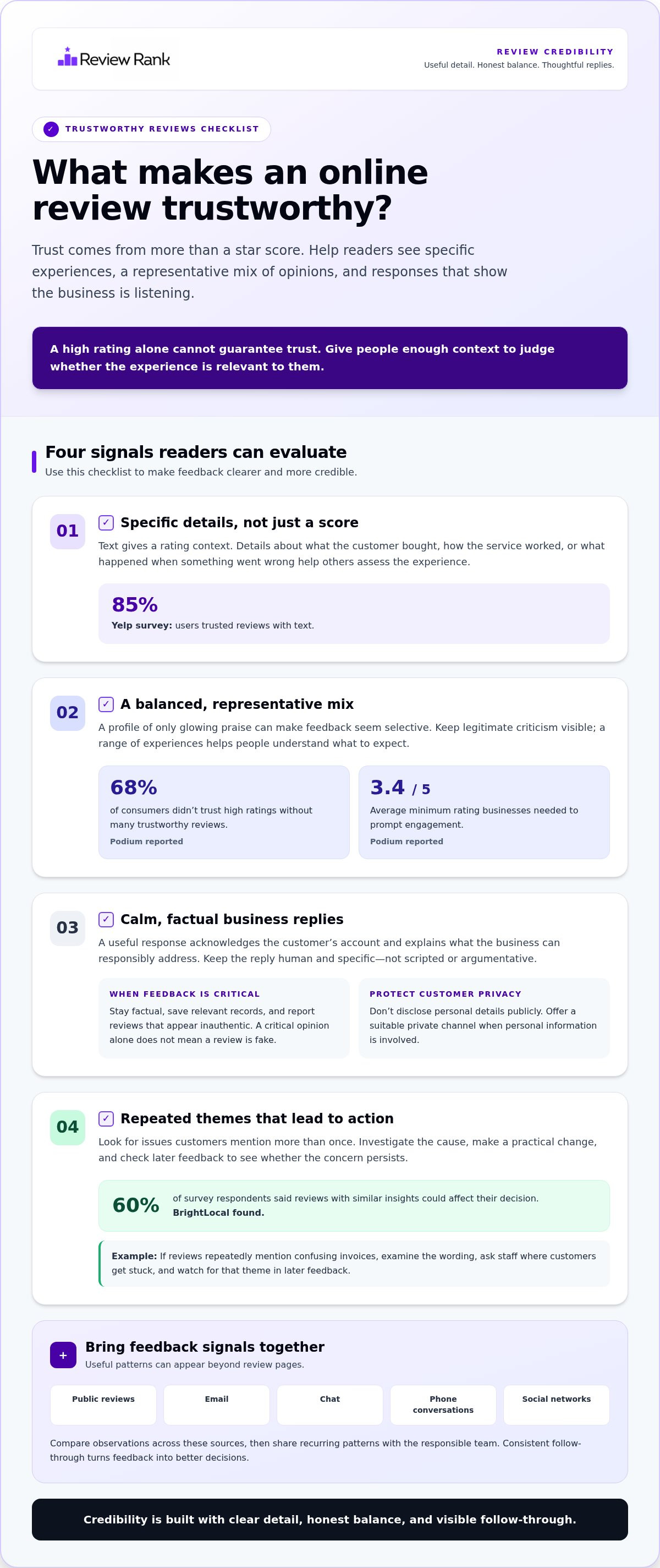
There’s no single rating or review count that guarantees trust. Podium reported that 3.4 stars out of five was the average minimum rating businesses needed to prompt engagement, while 68% of consumers didn’t trust high ratings without many trustworthy reviews. A credible profile gives people useful detail and a representative mix of customer experiences.
If a review seems fake or unfair, stay factual and avoid public arguments. Save relevant records, report reviews that appear inauthentic through the platform’s reporting process, and reply briefly with what you can verify. A critical opinion isn’t automatically fake, so address its specific claims without accusing the reviewer.
Text gives a rating context. Yelp’s 2022 survey found that 85% of users trusted reviews with text. A useful review might explain what a customer bought, how the service worked, or what happened when something went wrong. Specific details help readers judge whether the experience is relevant to their own needs.
Authenticity also depends on balance. A profile with only glowing praise can leave people wondering whether feedback is selective. Keep legitimate criticism visible, and make sure business responses provide information rather than pressure customers to change their decisions. For example, a repair shop could clarify what its service includes while acknowledging the reviewer’s concern.
Strong responses sound human, not scripted. Thank a positive reviewer for a detail they mentioned, such as a clear explanation or easy booking. For a complaint, acknowledge the customer’s account, explain what the business can responsibly address, and offer a suitable private channel for personal details. Never disclose customer information in a public reply.
Use repeated themes to guide business decisions. If reviews repeatedly mention confusing invoices, examine the invoice wording and ask staff where customers get stuck. Then update the explanation and watch for that theme in later feedback. BrightLocal found that 60% of survey respondents said reviews with similar insights could affect their decision, so recurring comments deserve attention.
Consistency across public feedback and business replies strengthens credibility. Check that responses reflect actual policies, service details, and changes the business has made. A practical review management workflow can help teams keep feedback and responses organized, while human judgment ensures each reply fits the customer’s specific experience.
A range of customer reviews, including occasional less-than-perfect ones, demonstrates transparency and shows how a business handles criticism. When several customers raise the same issue, such as slow delivery, explain how you’re responding and take action. Good customer service and straightforward, customer-focused interactions build online trust.
3. Asking customers for reviews at the right time
Ask soon after a customer has experienced the service, while useful details remain fresh. A completed appointment, resolved support issue, repeat purchase, or successful delivery can provide a natural moment. Around 65% of consumers are likely to leave a review when asked, so a clear, timely request can help customers share their experience.
Choose timing that fits what the customer bought. For a delivered product, a request 7–14 days after delivery gives the customer time to use it. For fast-moving goods, the suggested window is 5–10 days after delivery. A service business might ask after the appointment or after the customer has had time to assess the work.
Make it easy for customers to leave feedback. Send a concise email, WhatsApp message, or SMS with a direct link to the review platform. A café could send its request after a completed visit, while a repair business could invite feedback after the customer collects the repaired item. Send SMS reminders only to customers who opted into the business’s SMS program.
Ask for an honest review, not a positive one. The Federal Trade Commission has prohibited incentivized reviews. Don’t offer a reward for a review or ask only customers who seem satisfied. A neutral invitation, such as “Tell us about your experience,” gives customers room to share their genuine opinions and helps protect your credibility.
Keep the request brief and specific. Instead of asking customers to “write anything,” invite them to mention what they purchased, what worked well, or what could improve. For example, a hotel might ask guests to describe check-in, room comfort, or a helpful staff interaction. Prompts should encourage useful detail without scripting the review.
Use a measured reminder sequence instead of sending repeated messages at random. Suggested timing is a reminder 3 days after the first invitation, then another 7 days after that invitation. Stop once the customer responds, and keep the tone courteous. Review-request software can help coordinate timing across email and other channels, while staff should ensure messages fit the customer journey.
Review the process as part of your marketing, not as a one-off campaign. Track which customer moments and channels lead to completed reviews, then adjust the timing or message. If a delivery request gets little response, test a clearer link or better-timed follow-up. The goal is to encourage genuine feedback with minimal friction, not pressure customers to post.
4. Choosing general and industry-specific review platforms
Start with the platforms customers already use to discover businesses. In a recent survey, 87% of consumers reported using Google to find businesses in their area. That makes Google a practical priority for local businesses, including restaurants, dental clinics, and home service companies. Keep the profile accurate, especially its services, operating hours, and contact information.
Next, identify where customers in your industry share detailed experiences. A hotel might focus on platforms people use to compare stays, while a car repair garage might prioritize places customers visit before booking a service. Choose platforms that fit your customer journey, not simply every site with a rating feature. A neglected profile can leave questions unanswered.
General platforms can serve different needs. Yelp has been a staple since the early 2000s, while the Better Business Bureau rates businesses on a letter-grade scale from A-plus to F. Consider what each platform helps customers understand. A star rating offers a quick signal; written comments can provide experience details and context.
Build a manageable presence before expanding. Claim the profiles customers are most likely to encounter, then ensure each listing represents the same business accurately. A multi-location retailer should verify each store’s address and hours separately. An online business should keep its public details consistent across the profiles customers see.
Don’t assume reviews appear on just one site. Customers may leave feedback across many review platforms, so monitor the ones that matter most to your audience. A review-monitoring process can bring posts and ratings from multiple sources into one view, helping your team spot recurring issues without relying on occasional searches.
Set a regular review routine. Check new ratings, read the comments behind them, and assign someone to respond on each platform. For example, a café manager could review local listing feedback while head office tracks patterns across locations. Compare comments across platforms, since a service issue may appear on one site before another.
Share reviews responsibly. If you want to feature a customer’s review on your website or in other marketing, ask permission before publishing the quote. Keep the wording faithful to the original and make its source clear. A strong platform strategy connects discovery, credible ratings, and active listening, giving customers useful evidence without making every channel feel like an advertisement.
5. Using reviews to build customer trust
Reviews influence customer trust by giving prospective buyers evidence from other people’s experiences. Seventy percent of consumers say online reviews influence purchase decisions, while BrightLocal research found 50% trust reviews as much as personal recommendations from friends and family. A practical answer to how to build customer trust with online reviews is to turn that evidence into clearer expectations.
People often look for patterns, not just a headline rating. A 2022 Yelp survey found consumers read a median of five reviews before forming a brand impression that affects spending decisions. Consistent comments about clear communication or dependable service can help a reader picture what to expect.
Make those patterns easy to find. A review summary can surface repeated themes, but it shouldn’t replace individual customer voices. Forty-eight percent of consumers read a review summary first, while 18% said they would make a purchasing decision based on a summary alone. Keep supporting details accessible on review sites or your website.
Use reviews to show follow-through. If customers repeatedly praise a salon’s easy booking process, explain that process clearly on its website. If reviews identify a confusing return step, improve the instructions and update customer communications. What matters is taking action: customers can see that feedback informs decisions, not just promotional copy.
Keep the presentation balanced and consistent across customer touchpoints. A retailer can show specific product feedback alongside clear product details; a hotel can highlight comments about check-in and room comfort. Don’t edit a review to make it sound more positive. Preserve its meaning, identify it as customer feedback, and ask permission before reusing a quote.
Reviews can also help brands engage customers after their first visit or purchase. Edelman research found that 79% of consumers engage with brands by reading reviews or leaving feedback. Teams that want to learn how to build customer trust with online reviews can use recurring themes to shape service improvements, staff guidance, and the information prospective buyers need.
Track whether changes make a difference. Compare review themes over time with relevant customer actions, such as inquiries, bookings, repeat purchases, or abandoned orders. Treat these measures as signals to investigate, not proof that reviews alone caused a change. A consistent process connects customer feedback to decisions, visible improvements, and more informed buying.
Build a more consistent review process with tools for managing customer reviews.
Review Rank Ai: Automated Review Invites
Review Rank Ai helps businesses coordinate review requests and responses. Automated Review Invites can be sent through WhatsApp, SMS, and email. CRM sync and customer import connect customer information with the review-request workflow, making it easier to use existing business tools and customer records.
AI-Generated Review Responses support reply workflows, while Negative Feedback Filtering helps identify negative feedback for attention. The Google Local 3-Pack Leaderboard helps businesses monitor local search rankings. These features bring review activity and ranking monitoring into a more organized process.
Consider this approach when customer details sit in a CRM and review requests or responses are difficult to manage consistently. Visit Review Rank Ai to learn more.
Make customer feedback part of your next move
Trust grows through repeated actions customers can see. Choose a useful change to make based on recent feedback, then build a process for listening, responding, and improving. That’s how to build customer trust with online reviews: treat every review as a chance to understand what customers need and show how your business acts on it.
As your review process grows, Review Rank Ai offers Automated Review Invites, AI-Generated Review Responses, and a Google Local 3-Pack Leaderboard. These tools support review requests, response workflows, and local ranking monitoring as part of your wider customer experience approach.
Ready to make review management more consistent? Contact Review Rank Ai today and explore how its tools can support your next step. Keep listening, keep improving, and give customers more reasons to choose your business with confidence.
Frequently Asked Questions
What Makes an Online Review Trustworthy?
A trustworthy review describes a genuine customer experience in clear, specific terms. Details about the service received, a product’s use, or an aspect of a visit help readers judge whether the review is relevant. Check that it appears on its original platform and reflects what the customer wrote. For example, someone comparing plumbers can learn more from a comment about punctuality and completed work than from a star rating alone.
Why are customer reviews important for small businesses?
Customer reviews help small businesses show prospective buyers what working with them may involve. A neighborhood accountant, for example, can use feedback to illustrate how the team explains complex paperwork. Reviews can also reveal questions a business description overlooks. If customers repeatedly ask about booking, payment, or delivery, make that information easier to find before someone decides to get in touch or visit.
How can businesses ask customers for honest online reviews?
Invite customers to share genuine experiences without suggesting a particular rating or response. A bookstore might ask, “What did you think of your visit?” Send the same neutral request across the relevant customer experience, rather than selecting only people who seem pleased. Don’t offer rewards for reviews. The Federal Trade Commission has prohibited incentivized reviews, so keep requests independent of discounts or gifts.
When should businesses request a review after a purchase?
Ask when customers have enough experience to comment meaningfully. A restaurant can invite feedback after a completed meal, while a furniture seller may wait until the customer has received and used the item. For a professional service, a natural time may be after the agreed work is complete. Match the request to the experience being reviewed so customers can respond from firsthand knowledge.
Which review platforms matter most to customers in the United States?
For a local business, start with Google because consumers use it to find nearby businesses. Then consider platforms that suit your industry and customer journey. A restaurant might monitor Yelp, while a professional firm may also consider a relevant industry directory. Keep profiles accurate and active on the platforms customers actually consult. A focused presence is more useful than neglected listings across every review site.
How can businesses display reviews on their website without misleading customers?
Present reviews in their original meaning and identify the platform or source, the reviewer attribution as publicly shown, and any available date. Don’t rewrite comments, hide relevant context, or present selected praise as a complete picture. If you feature an excerpt, label it as an excerpt and, where practical, provide a route to the original review. Ask the reviewer’s permission before publishing their quote on your website.
What are the FTC rules for review requests, incentives, and endorsements?
Ask all customers for an honest review, not specifically a positive one, and don’t offer rewards for reviews. The Federal Trade Commission has prohibited incentivized reviews. If a business provides a service in exchange for feedback and permission to publish it, explain the arrangement clearly so readers can assess the review.