
Damage control for a 1-star review and your next steps
A one-star review deserves a prompt, professional response, not panic. For effective damage control for a 1-star review, acknowledge the concern, investigate what happened, and invite the reviewer to continue the conversation privately when appropriate. A calm reply shows other readers that you take feedback seriously.
A one-star review can affect your average rating and influence potential customers who see it. The impact depends partly on how many reviews you already have, but a thoughtful response can put the complaint in context and show how you handle problems.
This guide explains how one-star reviews affect your rating, what to say in a public response, and when to take the discussion offline. You’ll also learn how to tell an isolated complaint from a wider customer experience issue, so your next move is measured, useful, and focused on maintaining trust.
Key Takeaways
- Assess how much a one-star review may affect your average by considering your existing review count and rating.
- Respond calmly and personally: acknowledge the concern, address what you can, and avoid copy-and-paste replies.
- Move detailed or sensitive troubleshooting to a private channel, while keeping your public reply professional and helpful to future readers.
- Look for repeated complaints or safety concerns across reviews to distinguish a one-off issue from a broader problem.
- Build a consistent review routine with tools for invitations, response support, feedback filtering, and local ranking visibility.
1. What’s the Impact of a 1 star review to your score?
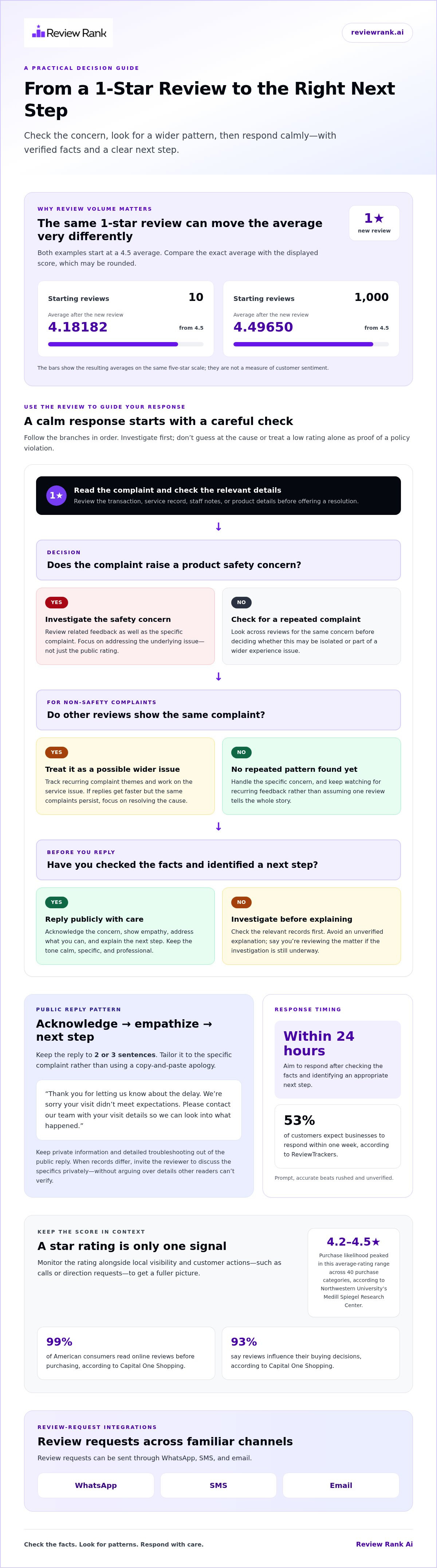
A one-star review can affect a business’s average and shape how potential customers view it. Capital One Shopping reports that 99% of American consumers read online reviews before purchasing, and 93% say reviews influence their buying decisions. For effective damage control for a 1-star review, assess the customer’s concern and the review’s effect on your rating. A measured response gives future readers useful context.
Review volume changes the arithmetic. A business with 10 reviews averaging 4.5 falls to an underlying average of 4.18182 after one additional one-star review. With 1,000 reviews at the same starting average, the new average is 4.49650. Compare the exact average with the displayed score, which may be rounded, before judging the size of the change.
Ratings can influence purchasing decisions, but one review alone doesn’t determine local visibility. Northwestern University’s Medill Spiegel Research Center found that purchase likelihood peaks at an average rating between 4.2 and 4.5 stars across 40 purchase categories. Monitor your rating alongside local visibility and customer actions, such as calls or direction requests. This gives you a fuller picture than the star score alone.
What is the best response time for a negative online review? Aim to respond within 24 hours, after checking the facts and identifying an appropriate next step. ReviewTrackers reports that 53% of customers expect businesses to respond within one week. A prompt, accurate reply shows readers that your business is attentive without rushing into an unverified explanation.
Investigate before you offer a resolution. Check the relevant transaction, service record, staff notes, or product details. If a customer’s problem appears to stem from incorrect product use, explain the correct steps clearly and respectfully. If the complaint raises a product safety concern, investigate it and review related feedback. Effective damage control for a 1-star review addresses the underlying issue, not just the public rating.
How do you request removal of a fake or policy-violating Google review? Report the review through Google Business Profile Manager, then use Google’s Reviews Appeal Tool to escalate multiple flagged reviews. Save screenshots, timestamps, and examples of repeated wording to document your concern. A low rating alone doesn’t establish a policy violation, so explain the specific issue rather than requesting removal just because the review is negative.
How do you track whether responding to negative reviews improves ratings and customer trust? Before changing your approach, record your average rating, review count, response time, and recurring complaint themes. Compare those measures over time with customer actions, such as calls or bookings. If replies become faster but the same complaints persist, focus on resolving the service issue rather than judging progress by the score alone.
2. Responding publicly with empathy and professionalism
A public reply speaks to two audiences: the reviewer and everyone reading later. Keep it calm, specific, and focused on the customer’s experience. BrightLocal’s 2025 consumer survey reports that 89% of consumers are likely to use a business that responds to both positive and negative reviews. A thoughtful response gives prospective customers a visible example of how your team handles concerns.
Use a simple structure: acknowledge the issue, show empathy, and explain the next step. Keep the reply to two or three sentences. For example: “Thank you for letting us know about the delay. We’re sorry your visit didn’t meet expectations. Please contact our team with your visit details so we can look into what happened.”
Tailor each reply to the complaint. If a café guest mentions a cold meal, acknowledge the food concern rather than posting a generic apology. If a customer describes a missed appointment, recognize the scheduling problem and say how you’ll review it. A specific detail shows you read the review and helps the response feel personal rather than copied.
Keep the public conversation factual. Don’t disclose customer records, speculate about motives, or argue over details other readers can’t verify. If your records differ from the reviewer’s account, say you’d like to understand more, then invite them to discuss the specifics privately. On Google and other review platforms, stay respectful even when a review feels unfair.
What should businesses avoid saying when responding to a bad review? Avoid insults, threats, blame, sarcasm, and unsupported claims. Don’t reveal private information or demand that the reviewer remove their post. Address the concern and offer a clear way to work toward a resolution.
Examples are most useful when they fit the situation. For a damaged delivery, acknowledge the inconvenience and explain how the customer can share order details privately. For a service misunderstanding, clarify the relevant process without accusing the reviewer of carelessness. If an investigation is underway, say you’re reviewing the matter instead of guessing at the cause.
How can a business encourage genuine positive reviews without violating platform rules? Invite customers to share honest feedback after an interaction, using the same neutral request for everyone. Don’t offer rewards for positive ratings or ask only satisfied customers. A fair invitation lets people describe their actual experience.
Make reply quality part of a repeatable process: assign a reviewer, check the facts, and personalize the response before posting. A consistent review-response workflow can help teams keep public replies organized without sacrificing a human tone.
3. How a one-star review affects a business’s average rating
A new one-star review lowers the average by adding a low score to the ratings already counted. The effect depends mainly on the number of reviews and their average. A business with fewer reviews will generally see a bigger change than one with hundreds of ratings. Check the actual average, not just the rounded score shown on the profile.
For example, a business with 50 reviews averaging 4.5 has an underlying average of 4.43137 after one additional one-star review. Its displayed rating may show 4.4. With 1,500 original reviews averaging 4.5, the average becomes 4.49767 after that same low score. The concern is understandable, but review volume changes the arithmetic, not the need to investigate the complaint.
How many positive reviews might help recover the original average? In one 50-review example, six new five-star reviews bring the public rounded score back to 4.5, while seven restore the original 4.5 average. These figures illustrate different recovery targets. A rounded display can return to its prior level before the precise average does, so define which result you’re tracking.
The starting profile matters, too. Six five-star reviews after a one-star review produce an average of 4.4706 for a business that began with 10 reviews averaging 4.5. For a business that began with 50 reviews at the same average, those six reviews bring the new average to 4.4912. The same positive feedback has a different mathematical effect depending on the review count.
Don’t use review requests to bury criticism. Invite customers to leave honest feedback consistently, and use rating patterns to guide your next steps. A steady flow of genuine reviews makes your profile more representative, while every complaint still deserves a direct response and appropriate investigation.
Prioritize reviews by rating and content. Businesses generally classify one- and two-star reviews as negative, three-star reviews as neutral, and four- or five-star reviews as positive. Start with the lowest ratings, but look for urgent issues in any review, whatever its score. For example, a three-star comment about a safety concern deserves prompt attention, even if lower-rated reviews are also waiting.
Track your rating and review count as you respond to and resolve complaints. Record the current average, then update it as new reviews arrive. This helps separate the effect of one complaint from the impact of later feedback. The goal isn’t a perfect score. It’s to resolve valid problems and build a credible record of customer experiences.
4. Distinguishing isolated complaints from broader problems
One one-star review may describe a single bad interaction, but recurring details can point to a process problem. Compare the complaint with other reviews, service records, and staff notes. Look for the same issue, location, product, or stage of the customer journey. One delayed appointment is different from repeated scheduling complaints across several branches.
Start a simple review log. Record the date, location, star rating, issue, and action taken. Then group similar concerns, such as billing confusion, missed bookings, damaged items, or staff communication. If a theme recurs across customer experiences, investigate the process behind it instead of treating each review as unrelated. The pattern can help direct attention to the right team.
Pay particular attention to health and safety concerns, even if they appear in just one review. Investigate the reported risk, check relevant records, and look for similar details in other feedback. For example, a complaint about a product causing an injury calls for a factual review of the product and circumstances. Don’t dismiss the concern because other ratings are positive.
If your business operates at multiple locations, compare their reviews. A sudden cluster of similar complaints at one branch may point to a local staffing or service issue. Similar reports across locations could indicate a shared process problem, or call for a closer look at timing and wording. Base conclusions on evidence, not assumptions about reviewers.
A sharp, unusual surge also needs careful documentation. In one reported case, a business owner described receiving about 40 one-star reviews over a couple of days and suspected coordinated activity. The owner estimated that an ex-customer had created between four and eight profiles. Those details can signal a situation to investigate, but they don’t prove the reviews are fake.
Preserve useful evidence as you assess reviews. Save screenshots and timestamps, note repeated or duplicate wording, and compare reviewer details with customer records. A review with no text or wording similar to other reviews may warrant closer examination, but neither detail alone establishes whether the reviewer was a customer. Organize the evidence before escalating a suspected policy violation.
Track incoming feedback alongside the work to resolve it. Assign recurring themes to the relevant team, monitor whether the underlying issue has been addressed, and check later reviews for similar reports. For example, if customers still mention unclear billing after staff guidance changes, revisit the explanation they receive. This makes review monitoring a practical improvement process.
Separate three questions: Is the complaint credible? Does it point to a recurring service issue? Is there evidence of coordinated or policy-violating activity? Answer each using records and review details. This helps you address genuine customer problems while documenting unusual patterns without making unsupported accusations.
5. Taking the conversation offline
Take a review discussion offline when resolving it requires personal details, order records, appointment information, or an extended exchange. Keep your public reply visible, then invite the reviewer to contact an appropriate team member privately. This protects sensitive details and gives your staff room to understand the situation without turning the review page into a case file.
Start with a short public bridge: acknowledge the feedback, say you’d like to investigate, and provide a clear contact route. For example: “We’re sorry the repair visit didn’t meet expectations. We’d like to review what happened. Please contact our service team with your appointment details.” Don’t ask the reviewer to post private information publicly.
Once the customer responds, gather only the details needed to identify the interaction. A hotel might ask for the stay date and booking name through a private support channel. A clinic could request appointment details through its established confidential process. Keep the conversation focused, and explain what information will help staff investigate the concern.
Then check the relevant records and agree on a practical next step. For a damaged delivery, review the order and explain the available ways to address the issue. If replacement is appropriate, describe the process clearly instead of promising an outcome before checking the facts. For a disputed appointment charge, compare the booking details with the customer’s account before responding.
Assign someone internally to make sure the complaint doesn’t disappear after the first message. Have one staff member track the issue, note the action taken, and follow up with the customer. If another team needs to investigate, tell the customer who will handle the next step. A clear handoff avoids repeated explanations and keeps the resolution moving.
After the private exchange, return to the review only if it’s useful. If the issue is resolved, you can post a brief, privacy-safe update thanking the customer for the opportunity to address it. Don’t share personal details about the outcome or pressure the reviewer to change their rating. They decide what feedback to share.
Taking the conversation offline doesn’t replace a public response. Future readers still need to see that you acknowledged the concern and offered a way to address it. If the customer doesn’t respond, leave your professional reply in place and document your outreach. Keep any further public messages focused on information relevant to other customers.
Use a consistent process for each complaint: acknowledge it publicly, move sensitive details to a private channel, investigate, and record the resolution. In addition, review recurring issues internally so customer feedback can inform service improvements. To support a more organized approach to review handling, explore review management tools.
Review Rank Ai: Automated Review Invites
Review Rank Ai helps businesses manage review requests and responses. Automated review requests can be sent through WhatsApp, SMS, and email. CRM sync and customer import connect customer information with the review workflow, while a single dashboard brings review activity together. This can help you build review requests into existing customer follow-up.
AI-Generated Review Responses support reply workflows, and the Google Local 3-Pack Leaderboard helps monitor local ranking visibility. Turn to these tools when managing review requests, feedback, or responses across your business becomes difficult to coordinate. Your team still investigates complaints and decides how to resolve them.
Visit Review Rank Ai to learn more.
Make your next review response part of a stronger process
A tough review can become a useful signal for what customers need next. Turn the lesson into a consistent routine: review feedback, assign follow-up, and make space for every customer to share an honest experience. That’s how damage control for a 1-star review becomes a deliberate part of managing your reputation, not a last-minute reaction.
Review Rank Ai supports that ongoing work with Automated Review Invites, AI-Generated Review Responses, and a Google Local 3-Pack Leaderboard. Use these tools to structure review requests, support response workflows, and monitor local ranking visibility. Your team still brings the judgment: investigate the issue, choose the right resolution, and keep sensitive conversations private.
Choose a next step that suits your operation. Make review follow-up more consistent, or use AI-powered response support to keep customer feedback moving through your process. Either way, steady attention helps you respond with purpose and learn from what customers share.
Contact Review Rank Ai to explore how it can support your review process. Every thoughtful response is a chance to move forward with greater confidence.
Frequently Asked Questions
Should you worry about one bad review?
Take a one-star review seriously, but assess it alongside your broader feedback and business records. A complaint about one interaction differs from a pattern across customers or locations. Check whether the account points to something you can verify, such as a booking, delivery, or service visit. Then decide whether to follow up with the customer, fix an operational issue, or document a suspected policy violation.
What’s the impact of a 1 star review to your score?
A one-star review lowers the arithmetic average. How much it changes depends on your existing review count and average. To estimate the effect, multiply each star rating by its review count, add the totals, then divide by the new total number of reviews. Compare the result with the displayed rating, which may be rounded. This shows whether the visible score changed or only the underlying average.
How should a business respond to a 1-star review?
Respond to the reviewer’s specific concern and give readers a clear next step. For example, if a customer says an invoice included an unexpected charge, acknowledge the concern and explain how your team can review the account privately. Avoid debating details in public. Before posting, ask someone familiar with the service to check that your reply is accurate, respectful, and free of private customer information.
How do you apologize to a customer in a public review response?
Apologize for the customer’s experience without making claims you haven’t verified. A useful response might say, “We’re sorry the appointment process caused confusion. We’re reviewing how the information was shared and would welcome the chance to understand your experience.” Name the specific frustration rather than offering a generic apology. If your review confirms a mistake, acknowledge it plainly and explain the appropriate next step.
Can a business offer a refund or compensation after a 1-star review?
A business can consider a refund, exchange, or other remedy when it fits the facts and its established policies. First, verify the purchase or service, understand what went wrong, and apply the same criteria you would outside a public review. Keep any offer private and separate from a request to change or remove a rating. A remedy should address the customer’s problem, not buy a more favorable review.
How do you contact a reviewer privately and resolve the complaint?
Reply publicly with a brief invitation to continue through a suitable private channel, such as your customer support email or established account contact. Don’t ask the reviewer to share booking details, health information, or order numbers on the review page. In private, confirm the relevant transaction, listen to the customer’s account, and agree on a clear follow-up. Record the outcome internally so staff can handle further contact consistently.