
Company Reputation Management and the Role of Customer Reviews
A company’s reputation is shaped by what customers experience and share online. Company reputation management means monitoring that feedback, responding thoughtfully, and addressing issues that could weaken trust. Reviews are a visible part of the picture, but they’re not the whole story.
It’s easy to think reputation comes down to a star rating. In practice, people also notice how a business handles criticism, whether it responds to feedback, and whether its public message matches the customer experience.
This article explains what online reputation management involves, how reviews and customer feedback shape trust, and who is responsible for keeping the work on track. It also explores how priorities differ across industries, from hospitality and healthcare to local services and ecommerce. You’ll get a clearer picture of the work involved and how review tools can help businesses manage feedback consistently.
Key Takeaways
- Respond to positive and negative reviews with a timely, professional approach that shows customers their feedback matters.
- Monitor reviews and public conversations to spot recurring concerns and understand how people describe your business.
- Use satisfaction scores and customer testimonials as useful signals, while looking beyond ratings to the experiences behind them.
- Set clear responsibility for reputation management so feedback is reviewed, responses are coordinated, and recurring issues reach the right teams.
- Adapt your approach to your industry and use review tools to manage invitations and responses across customer communication channels.
Responding to positive and negative reviews
Review responses turn customer feedback into a public record of how a business listens and acts. Effective company reputation management pairs consistent monitoring with genuine replies and a fair approach to collecting reviews.
Responding to Positive Reviews
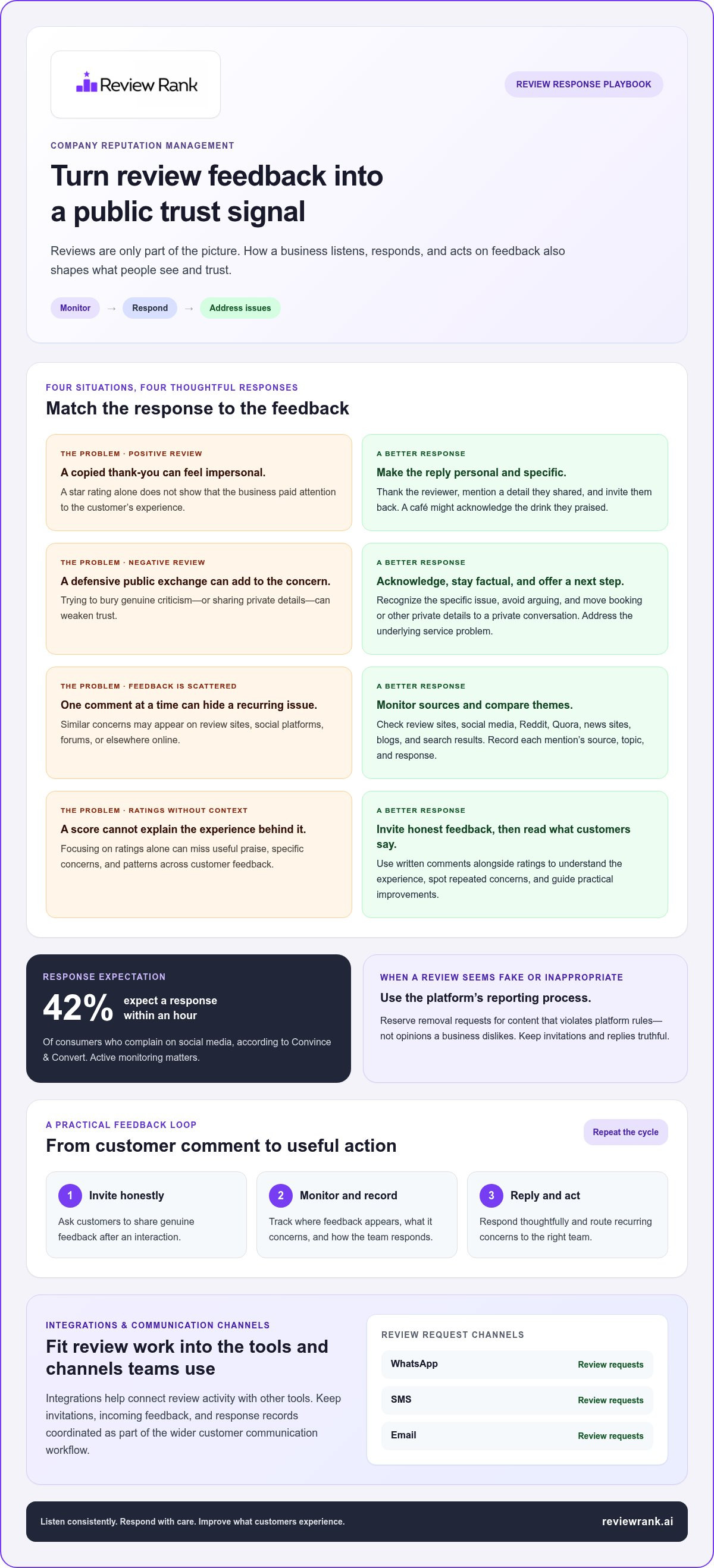
A response to a positive review acknowledges the customer’s experience and adds a personal touch. Thank the reviewer, mention a specific detail, and invite them back without relying on a copied script. For example, a café can thank a guest for praising a particular drink. Thoughtful replies show prospective customers that the business pays attention to feedback, not just star ratings.
Review collection and responses work together. Invite customers to share honest feedback after an interaction, then read what they write before replying. A response can also surface useful customer comments, such as praise for a clear booking process or a concern about wait times. According to Convince & Convert, 42 percent of consumers who complain on social media expect a response within an hour, making active monitoring important.
Monitor more than review sites. Check social media, forums such as Reddit and Quora, news sites, blogs, and search results for mentions of your business. A Facebook complaint may point to the same service issue appearing in a Google review. Record the source, topic, and response so your team can spot recurring feedback instead of treating every comment as an isolated event.
Managing Negative Reviews and Feedback
Managing a negative review means understanding the complaint, responding professionally, and addressing any underlying service issue. Acknowledge the specific concern, avoid arguing in public, and explain a practical next step without sharing private details. For example, a hotel can recognize a guest’s concern about room cleanliness and invite them to discuss booking details privately. Keep the public reply calm and factual.
Not every negative review should be removed. Report feedback that appears fake or inappropriate through the platform’s process, and respond to genuine criticism rather than trying to bury it. Suppressing feedback can make it less representative and undermine trust if customers notice missing comments. Reserve removal requests for content that violates platform rules, not opinions a business dislikes.
In the U.S., businesses should follow applicable consumer-protection requirements and each review platform’s policies. Keep review requests and replies truthful: don’t fabricate praise or present customer feedback misleadingly. The relevant rule can depend on the conduct and platform, so don’t treat removal or suppression as a default response.
The cost of reputation management in the United States depends on the work involved. Factors include review volume, number of locations, monitoring coverage, response needs, and whether a business relies on software, in-house staff, or outside support. Assess those needs before comparing approaches, rather than relying on a single figure that may not suit your operation.
Strong strategies combine regular monitoring, honest review invitations, timely personalized replies, and action on recurring complaints. Local businesses can strengthen their presence on Google and other review sites by inviting customers to share genuine experiences, responding to positive and negative feedback, and reporting reviews that appear fake or inappropriate. For example, a restaurant can track repeated comments about reservation handling and address the underlying operational issue.
What is Online Reputation Management?
Online reputation management means tracking and shaping how a business appears across the internet. Monitoring turns scattered mentions, ratings, and feedback into signals teams can assess and act on.
Online Reputation Management and Monitoring
Online reputation management combines monitoring public information about a business with responding to issues that could affect trust. It matters because customers may encounter a review, forum post, or news story before visiting the company’s website. Monitoring helps teams find those sources and understand what people see.
Build a regular review routine around the channels your customers use. Check Google search results, review sites, social media, forums, news sites, and blogs. For example, a hotel might search its name alongside terms such as “check-in” or “room cleanliness.” This can uncover specific concerns that a general search for the hotel’s name might miss.
Tracking Brand Mentions and Sentiment
Brand-mention tracking records where a company appears online, while sentiment tracking groups comments by tone and topic. Together, they help teams distinguish an isolated complaint from a recurring customer experience issue. A retailer, for example, might find praise for delivery speed alongside repeated concerns about returns.
Record the source, date, topic, and tone of each relevant mention. Then compare themes across channels instead of treating every post separately. A rise in negative Facebook comments may connect to similar feedback on Google or a consumer forum. Consider ratings alongside written comments: the score gives a quick measure, while the text explains the experience behind it.
Choose performance measures that connect monitoring to business priorities. Track changes in review themes, response completion, ratings, and relevant actions such as enquiries or bookings. Compare measures over consistent periods and note other changes, such as a new service process. This gives teams a clearer basis for assessing whether reputation work supports business outcomes, rather than assuming every change came from one activity.
Reputation Crises and Measurement
Reputation monitoring supports crisis response by helping teams spot unusual attention and coordinate a clear reply. A sudden cluster of comments about a product issue, for example, calls for checking the facts before responding publicly. A crisis protocol can define approved messaging, a designated spokesperson, and a response timeline.
To measure return on investment, compare the resources spent on reputation work with outcomes tied to its goals. Track indicators such as review trends, customer enquiries, bookings, and repeat complaints over time. Add context: changes in bookings may also reflect seasonality or pricing. Clear attribution matters more than claiming every improvement as a direct result.
Teams that want to streamline feedback workflows can explore review response management tools alongside their monitoring process. The essential measurement discipline remains the same: connect each action to a defined outcome, then review the evidence across channels.
Customer satisfaction scores and testimonials
A satisfaction score summarizes customer feedback, while a testimonial adds context. Read them together to understand what customers value and where the experience falls short.
Customer Trust and Brand Credibility
Brand credibility grows when public claims match the experiences customers describe. BrightLocal’s 2018 Local Consumer Review Survey found that 86 percent of consumers read reviews for local businesses. That makes reviews part of how potential customers assess a business before choosing it.
A rating offers a quick signal, but testimonials explain what lies behind it. A dental clinic might receive praise for clear appointment communication and criticism about long waits. Those details help prospective patients decide whether the clinic suits their needs and give the business more useful insight than an average score alone.
Use scores as indicators, not as the whole story. BrightLocal’s survey found that 57 percent of consumers would only buy from a business with four or more stars. A low score can prompt closer attention, but written feedback can reveal whether the problem concerns one service, location, or point in the customer journey.
Feedback, Engagement, and Customer Experience
Customer experience management uses feedback to identify friction and improve interactions throughout the customer journey. For example, an online store can group comments about delivery, product descriptions, and returns. The patterns show which parts of the experience need attention, while individual testimonials add detail to each theme.
Negative feedback is useful when a business treats it as evidence, not an attack. Categorize the issue, acknowledge the customer’s concern, and send it to the team that can address the underlying cause. If several hotel guests mention confusing check-in instructions, clearer arrival information may improve the experience for future guests.
Engagement continues after a public response. A business can follow up through an appropriate private channel, explain what action it took, and record whether the issue recurs. This creates a feedback loop: customer comments inform service changes, and subsequent responses help show whether those changes address the problem. Don’t promise fixes that teams haven’t implemented.
Testimonials can help businesses understand which moments customers find meaningful. A fitness studio might see members repeatedly praise flexible class times and use that insight when reviewing its schedule. On a digital profile or search listing, accurate testimonials give potential customers concrete examples of the experience. Keep them genuine and representative, rather than selecting feedback that hides recurring concerns.
For a useful review, compare the satisfaction score with recurring themes, customer responses, and changes made. BrightLocal’s 2018 survey found that 40 percent of consumers considered only reviews written within the past two weeks. Recent feedback can therefore offer a timely view, while older testimonials may still explain longer-standing strengths.
Responsibility for reputation management
Reputation management works best when one person coordinates the work and teams share responsibility for customer-facing actions. Clear ownership helps a company respond consistently across review platforms, social media, and news coverage.
Public Criticism and Crisis Response
Public criticism and crisis response involve assessing a concern, assigning the right lead, and communicating accurate information. This matters because inconsistent replies can deepen confusion while consumers discuss an issue across platforms. A designated spokesperson can coordinate public statements, while operational teams investigate what happened and report verified details.
A crisis protocol should define approved messaging, a designated spokesperson, and a response timeline. For example, if customers report a product issue on social media, the monitoring lead can alert the relevant team, preserve the original comments, and escalate the matter. The spokesperson can then share confirmed updates, while marketing coordinates messages across other public channels.
In-House Reputation Management
In-house reputation management assigns monitoring and response work to employees who understand the company’s services and decisions. Internal teams can connect public feedback to operational changes. For example, a restaurant’s service manager can investigate reservation complaints and coordinate with front-of-house staff before publishing a response.
Assign ownership by task: customer service reviews incoming feedback, marketing monitors brand mentions, and senior leadership handles sensitive criticism. A shared log can record the platform, issue, owner, and next action. This helps prevent customer comments from being missed between teams, especially when a concern involves service, communications, and operations.
Reputation Management Agencies
A reputation management agency provides external support for agreed monitoring, analysis, or communications work. It can help when internal staff lack capacity or need specialist support across digital channels. The agency still relies on company teams for accurate facts, operational decisions, and approval of statements made on the business’s behalf.
Compared with in-house work, an agency adds outside capacity, while employees bring direct knowledge of customers and internal processes. The right arrangement depends on response volume, channel coverage, available staff, and how closely feedback connects to daily operations. Some companies keep decisions and sensitive replies in-house, then use outside support for monitoring or reporting.
Responsibility should follow the issue, not just the platform. A billing complaint may need customer service; a recurring product concern may require operations; a public statement may need leadership approval. Set a clear escalation path so each report reaches someone able to act. Marketing can coordinate tone and timing, but the team closest to the cause should own corrective action.
Review the process after each significant incident. Check whether the monitoring team spotted the concern, whether the spokesperson had verified information, and whether promised actions reached the responsible team. These checks turn a public response into an internal learning loop. Clear roles, documented handoffs, and follow-through make reputation work part of customer experience, rather than a task left to marketing alone.
Reputation management across multiple industries
The right reputation strategy depends on what customers value, how they buy, and where they share feedback. A restaurant, medical clinic, and software company need different signals, response practices, and search priorities.
Food and hospitality businesses are judged through specific service moments. A restaurant may track comments about reservations, menu accuracy, and meal timing. A hotel may focus on check-in, room condition, and staff communication. These details help teams connect reviews to the customer journey and address issues that could deter future guests.
Healthcare providers face a different balance. A dental clinic can monitor feedback about appointment access, wait times, and how clearly staff explain visits. Responses should protect private information and avoid discussing an individual’s care in public. Acknowledge the concern without revealing details, then route service issues to the appropriate internal team.
For professional services, trust often depends on clear communication and reliable follow-through. An accounting firm might look for recurring comments about response delays or confusing explanations. A law firm may monitor whether clients understand next steps. These businesses can use themes in public feedback to improve client communication while keeping replies factual and professional.
Retail and ecommerce brands should distinguish product issues from delivery or returns concerns. If customers repeatedly mention unclear sizing, a fashion retailer can review product descriptions. If comments point to delayed updates, the business can examine its order communications. Separating these themes helps teams address the actual problem instead of treating every low rating alike.
Local service businesses, such as plumbers or cleaners, can pay close attention to punctuality, estimates, and work quality. A single-location business can compare feedback across its service experience. A franchise group needs shared standards while still identifying branch-specific concerns. Consistent categories make comparisons useful without assuming every location faces the same issue.
For online businesses and software companies, customers may discuss onboarding, usability, support, or reliability across review sites, forums, and social media. Monitoring these sources can reveal a developing issue before it dominates search results. A sudden cluster of similar complaints should trigger a clear internal process: confirm the facts, assign an owner, and coordinate public updates.
Across industries, start with the customer decision the business wants to influence. Identify the channels customers use, the experience details they mention, and the team responsible for acting on that feedback. Then compare patterns over time. A Google Local 3-Pack Leaderboard can help a local business monitor its position in Google’s local results, while reviews explain what customers say about the experience behind that visibility.
Ready to make review performance easier to assess? Explore tools for managing your review presence.
Review Rank Ai: Automated Review Invites
Review Rank Ai supports review collection and response workflows with Automated Review Invites and AI-Generated Review Responses. Invitations can be sent through WhatsApp, SMS, and email, connecting review requests with familiar customer communication channels. Businesses can explore the available review platform integrations to understand how these workflows fit alongside their other tools.
The Google Local 3-Pack Leaderboard helps businesses monitor local search rankings. Choose the tools that match your needs, whether you’re organizing review invitations, managing responses, or tracking local visibility.
Visit Review Rank Ai to learn more.
Make Your Next Reputation Move Count
Strong reputation work rests on a repeatable commitment: listen to customers, learn from their experiences, and make improvements visible in how your business operates. Treat company reputation management as an ongoing business practice, not a campaign that ends after a few replies. The next step is choosing a workflow your team can sustain.
Review Rank Ai brings together Automated Review Invites, AI-Generated Review Responses, and a Google Local 3-Pack Leaderboard. These tools can support review collection, response management, and local visibility as your team puts its approach into practice. Choose the support that fits your priorities, then keep ownership of customer experience and decisions within your business.
Ready to explore a more organized review workflow? Contact Review Rank Ai to learn how its tools fit your reputation goals. Start with a clear process, build on real customer feedback, and keep moving forward.
Frequently Asked Questions
How Can You Monitor Your Brand's Reputation?
Monitor your brand by tracking how customers describe your business wherever they discuss it. Search your business name, location names, product names, and common misspellings. Keep a simple record of recurring themes and notable changes. For example, a bakery could track comments about custom orders separately from feedback about in-store service, making it easier to identify which part of the experience needs attention.
What is company reputation management?
Company reputation management is the work of understanding and influencing how customers and the public perceive a business. It includes paying attention to public feedback, communicating with customers, and addressing operational issues that shape their experiences. The aim isn’t to make every comment positive. It’s to build a clear picture of what people say, respond responsibly, and use relevant insights to guide business decisions.
How can a company monitor its online reputation?
Review your business name and locations regularly across search engines, review platforms, and public discussions. Check results once or twice a week, then separate relevant mentions from unrelated uses of the same name. A multi-location clinic, for example, can label feedback by branch so a local service concern isn’t mistaken for a company-wide pattern. Assign someone to record significant changes and route issues internally.
How should a company respond to negative reviews and complaints?
Address the customer’s specific concern with a calm, factual reply, then gather the details needed to investigate privately. Don’t disclose personal or account information in a public response. If the complaint identifies a real service issue, explain corrective action only after the responsible team confirms it. For recurring complaints, record the underlying cause and follow up internally so each response supports a useful operational fix.
How can a company remove or dispute false online reviews?
Use the platform’s reporting process when a review appears to violate its content rules. Save relevant records, such as booking or transaction details, and state the specific reason for your report. A review that simply expresses dissatisfaction isn’t automatically false or removable. Don’t argue with the reviewer publicly or try to bury the comment with fabricated praise. Keep any public reply brief, factual, and focused on resolving the customer’s concern.
What are the legal rules for online reviews and reputation management in the U.S.?
Businesses should follow applicable consumer-protection requirements and each review platform’s policies. Review requests and replies must be truthful. Report content that violates platform rules instead of trying to remove genuine opinions.
How much does company reputation management cost in the United States?
The cost of company reputation management in the United States typically ranges from a few hundred dollars per month for basic monitoring tools to several thousand dollars monthly for comprehensive agency services. Pricing depends heavily on business size, the current state of your brand image, the volume of reviews, and whether you need active crisis response or standard proactive tracking with partners like Review Rank Ai.