
Common Mistakes in Online Review Management, and How to Fix Them
Most review-management failures don’t start with a lack of customer feedback. They start when review requests, responses, and follow-up vary from one team or location to another. These common mistakes in online review management can leave customers feeling ignored and useful feedback sitting idle.
You already know reviews matter. The challenge is keeping the process consistent without making every interaction feel scripted or adding another manual task to an already busy team. The fix isn’t to automate every human touch. It’s to build a repeatable workflow that makes timely, genuine engagement easier.
This article breaks down habits that can erode trust, from inconsistent review requests to unanswered feedback and missed opportunities to improve operations. You’ll learn how to collect reviews through WhatsApp, SMS, and email, respond efficiently with human oversight, and connect review activity with your existing tools. The goal is to give your whole business a clear, practical system for managing feedback.
Key Takeaways
- Spot common mistakes in online review management, including inconsistent invitations, selective outreach, and feedback that goes unanswered.
- Build a repeatable workflow by assigning ownership, standardizing review requests, and making time to learn from customer feedback.
- Compare manual processes with automation to see where consistent invitations and response support can reduce staff workload.
- Use integrations to connect review activity with existing tools and workflows while keeping customer feedback genuine.
- Match software capabilities to the gaps you need to fix, from WhatsApp, SMS, and email invitations to review visibility and reuse.
Why Common Online Review Management Mistakes Cost More Than a Few Stars
A review score is only a snapshot. Behind it is a process: inviting customers to share feedback, monitoring public reviews, responding, and using recurring themes to improve how the business operates. When any step is inconsistent, customers may see unanswered concerns, and the feedback collected may not reflect the full customer experience. That’s why common mistakes in online review management can weaken trust even when the average rating looks strong.
Review management is one part of the broader practice of Reputation management, with a specific focus on public customer reviews and the workflow around them. It isn’t paid promotion, a substitute for broader brand communications, or a replacement for resolving an individual customer’s issue through the appropriate service channel. A public response can acknowledge a concern, but the business may still need to follow up directly and address the underlying problem.
Ethical review collection invites customers to share honest experiences without steering what they say; review manipulation tries to control which feedback appears or what it contains. That distinction matters. The goal isn’t a flawless rating. It’s a dependable process that represents genuine experiences and treats feedback consistently.
What an effective review-management process needs to do
Map the journey from completed service to invitation, public review, and response. Decide who owns each handoff and when it should happen. Without clear ownership, a completed appointment may never trigger an invitation, or a new review may sit unnoticed because each team assumes someone else is monitoring it.
Fit the workflow to the operation. A local café might have a manager monitor feedback and coordinate follow-up. A multi-location brand needs clear responsibilities across branches and a way to spot recurring themes centrally. A high-volume service business may need a consistent invitation process so feedback doesn’t depend on one employee remembering each request. The tools can differ, but ownership and purpose should be clear.
Why a high rating alone is not a reliable strategy
A rating shows how customers scored their experiences, but it can’t explain what caused those scores. A restaurant’s average may conceal repeated comments about slow service. A clinic may receive positive ratings while customers still describe confusion about appointment communication. Review themes and response habits give teams context that a single number can’t provide.
Separate visible performance from operational learning. Track ratings and review activity, but also look for recurring issues, unanswered feedback, and inconsistent responses. A strong process doesn’t chase stars at the expense of honest feedback. It makes real customer experiences easier to hear, address, and learn from.
Eight Common Review Management Mistakes That Erode Trust
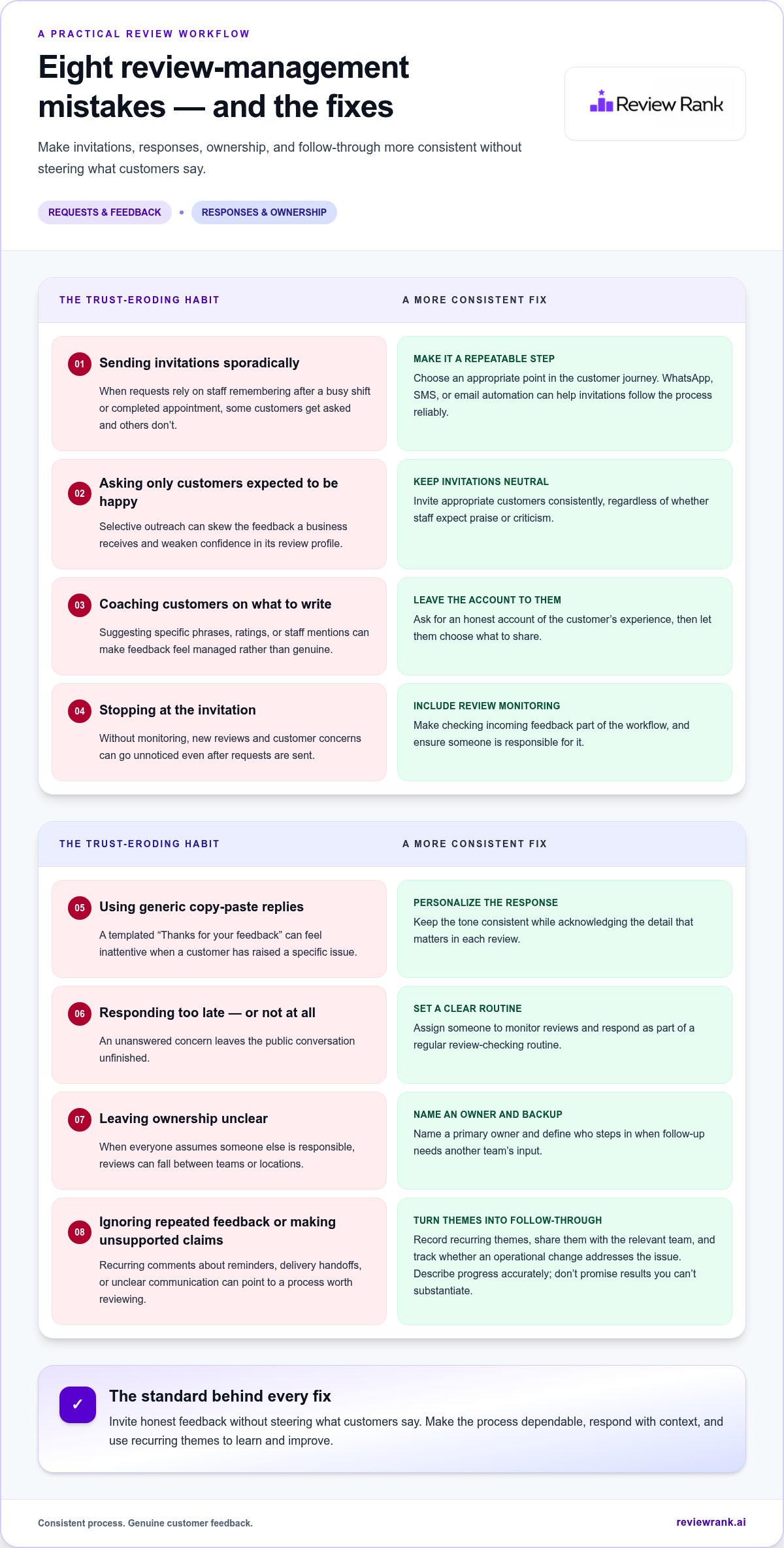
Many common mistakes in online review management come down to weak handoffs: requests depend on memory, responses lack context, or feedback never reaches the people who can act on it. Use these eight mistake-and-fix pairs to make your workflow more consistent without steering what customers say.
Mistakes in review requests and feedback collection
- Sending invitations sporadically. If requests rely on staff remembering after a busy shift or completed appointment, some customers get asked and others don’t. Fix: Choose an appropriate point in the customer journey and make invitations a consistent step. Automation through WhatsApp, SMS, or email can help the team follow the process reliably.
- Asking only customers expected to be happy. Selective outreach can skew the feedback a business receives and weaken confidence in its review profile. Fix: Use a neutral invitation process for appropriate customers, regardless of whether staff expect praise or criticism.
- Coaching customers on what to write. Suggesting specific phrases, ratings, or staff mentions can make feedback feel managed rather than genuine. Fix: Ask for an honest account of the customer’s experience, then let them choose what to share.
- Stopping at the invitation. Requests may bring in feedback, but without monitoring, new reviews and concerns can go unnoticed. Fix: Include review monitoring in the workflow and make sure someone checks incoming feedback.
Mistakes in responses, ownership, and follow-through
- Using generic copy-paste replies. A templated “Thanks for your feedback” can feel inattentive when a customer has raised a specific issue. Fix: Keep the tone consistent, but acknowledge the detail that matters in each review.
- Responding too late, or not at all. An unanswered concern leaves the public conversation unfinished. Fix: Set a clear review-checking routine and assign someone to monitor and respond.
- Leaving ownership unclear. When everyone assumes someone else is responsible, reviews can fall between teams or locations. Fix: Name a primary owner and define who steps in when follow-up needs another team’s input.
- Ignoring repeated feedback or making unsupported claims. Repeated comments about appointment reminders, delivery handoffs, or unclear communication can point to a process worth reviewing. Fix: Record recurring themes, share them with the relevant team, and track whether an operational change addresses the issue. Describe progress accurately; don’t promise results you can’t substantiate.
A structured system can help teams manage invitations and responses without replacing genuine customer feedback. Explore review management tools and workflows to organize the process.
Manual Review Workflows vs. Automation: Compare the Real Trade-Offs
Manual tracking can work when one person owns the process and reviews arrive at a manageable pace. But as invitations, locations, and review channels multiply, a spreadsheet and shared inbox can lead to missed handoffs. Automation helps execute a defined workflow consistently. It doesn’t replace judgment, thoughtful responses, or the work of resolving a customer’s concern.
| Approach | Consistency | Staff workload | Visibility and response support | Fit with existing processes |
|---|---|---|---|---|
| Manual tracking | Depends on staff routines and reminders. | More copying, checking, and follow-up by hand. | Reviews may be spread across sites or records; replies rely on individual effort. | Easy to start, but can create duplicate entry. |
| Basic automation | Can standardize selected repeatable steps, such as sending invitations. | Reduces some routine tasks. | Can help with requests, while monitoring and responses still need clear ownership. | Useful for a defined task, though activity may remain split across tools. |
| Connected review-management platform | Can bring repeatable review tasks into a more coordinated workflow. | Can reduce manual handoffs when relevant processes connect. | Can bring review visibility and response assistance together; people still need to check context. | Assess it by how its integrations fit the tools and workflows already in use. |
When a manual process is enough, and when it breaks down
A simple process may be enough if one person can reliably send invitations, check review channels, and coordinate replies. Look for warning signs rather than relying on a fixed business-size or customer-volume cutoff: invitations are missed, review details are scattered across records, or staff give inconsistent replies. Those gaps point to a need for clearer ownership, automation, or both.
How to assess integrations without adding tool sprawl
Start with the repeated handoff you want to remove. An integration is useful when it connects a relevant customer workflow to review activity and reduces duplicate entry, not simply because another tool is connected. Review Rank Ai sends review requests through WhatsApp, SMS, and email. Its review platform integrations connect review activity with business workflows. Focus on the connections that fit your process and avoid adding complexity without a clear purpose.
For more context on the role of automation, read Automated Reputation Management Software: The 2026 Guide to Market Dominance. The right system can reduce repetitive work, but people must still review AI-assisted responses, use judgment with sensitive feedback, and follow through on service recovery. Automation supports the process; it doesn’t make decisions accountable for you.
A Practical Review Management Reset for Any Industry
A reliable review workflow doesn’t need to be complicated. It needs clear steps, named owners, and a way to turn feedback into action. Use this six-step reset to address common mistakes in online review management without making the process feel scripted.
- Audit the current process. Map where reviews appear, how customers are invited, who monitors feedback, and where responses get stuck. Note gaps by location or customer touchpoint.
- Assign ownership. Name the person responsible for monitoring reviews and routing issues. For multiple locations, define what branch teams handle and what needs central oversight.
- Standardize invitations. Choose an appropriate point after the customer experience and use the same neutral request process. Send review requests through WhatsApp, SMS, or email, choosing channels that fit your customer workflow.
- Respond with care. Document response principles, such as acknowledging the customer’s concern and keeping replies respectful. Personalize each response to the feedback. Route sensitive, complex, or escalated issues to a person for review before replying.
- Learn from patterns. Group recurring feedback by location, service, or customer journey stage, then share relevant themes with the team that can address them.
- Measure the process. Track whether invitations are sent consistently, reviews are monitored, responses are handled, and recurring issues receive follow-up. Use what you learn to refine the workflow.
In short: audit the workflow, assign owners, standardize invitations, respond thoughtfully, learn from patterns, and measure follow-through.
Build a repeatable invitation and response routine
Make the invitation part of a real customer touchpoint, such as after a restaurant visit, a completed clinic appointment, or a home-service job. Keep the request neutral and consistent rather than selecting customers based on expected ratings. Clear ownership helps ensure new feedback is noticed and routed to the right team. For practical response guidance, see the AI review response generator guide, and treat AI-assisted drafts as a starting point, especially when an issue needs human judgment.
Turn review patterns into operational learning
One comment can flag an individual experience; repeated themes may reveal a process worth examining. A restaurant might group feedback about order handoffs, a clinic might review comments about appointment communication, and a home-services team might track feedback about arrival updates. Professional services firms can look for recurring questions about next steps. Multi-location brands can compare themes across branches to spot where a process needs attention, without assuming every location has the same issue.
Use review-management software to support a consistent workflow, not to replace customer care. Explore review management tools to organize invitations, responses, and feedback learning.
Choose Review Management Software That Fixes Your Actual Mistakes
Feature count isn’t the test. The right platform should address the common mistakes in online review management your team has identified and fit the way customer feedback already moves through the business. Start with the workflow gap, then assess the capability that could help close it.
A mistake-based checklist for evaluating a platform
- Requests are inconsistent: Assess whether invitations can be automated and sent through suitable channels. Review Rank Ai supports review requests through WhatsApp, SMS, and email.
- Replies are delayed: Look for AI-generated response support that helps teams handle reviews efficiently. Keep human oversight in the process, especially for sensitive feedback or issues that need service recovery.
- Review activity is fragmented: Look at whether integrations can connect review activity with relevant existing workflows and reduce duplicate entry. Review the integrations page to understand how the platform can fit into your tools and processes.
- Feedback is hard to track or reuse: Assess whether the platform provides review visibility and helps put customer feedback to work beyond the review page.
Match each capability to a clear need. A business with a reliable invitation routine may get more value from response support or a clearer view of review activity than from another way to send requests. A multi-location team may prioritize shared visibility and consistent processes across branches. Don’t treat a feature list as proof of fit, and don’t assume software will guarantee higher ratings, rankings, or revenue.
What a connected review workflow can look like
Review Rank Ai brings several review tasks together. Automated invites can request feedback through WhatsApp, SMS, or email. AI-generated review responses support faster handling, while people can review drafts and use judgment where context matters. The Google Local 3-Pack Leaderboard tracks local visibility; it doesn’t promise a particular position. Negative-feedback filtering is another platform capability, and reviews can also be repurposed automatically for social media and company websites.
Integrations are useful when they connect review activity to tools your team already uses instead of creating disconnected steps. Consider how a connection fits into the customer journey and whether it addresses a real handoff problem. The goal is a workflow that supports consistent execution while leaving room for genuine customer feedback and human decisions.
Ready to bring invitations, responses, visibility, and review reuse into a more organized process? Explore the automated review management platform.
Build a Review Workflow Your Team Can Trust
Common mistakes in online review management are rarely fixed by chasing a higher rating. They’re fixed by making review requests consistent, assigning clear ownership, responding with care, and using recurring feedback to guide practical improvements.
Automation can make those steps easier to repeat, but it shouldn’t replace genuine feedback or human judgment. Review Rank Ai supports review requests through WhatsApp, SMS, and email, AI-generated responses to help teams handle replies, and a Google Local 3-Pack Leaderboard to track local visibility. These tools help organize the work without promising a particular rating, ranking, or business result.
Start with the process that’s causing friction, then choose tools that solve that specific problem. A dependable system gives every location and team a clearer path from customer experience to useful feedback and thoughtful follow-through.
Explore the automated review management platform and take the next step toward a more consistent, customer-centered workflow. With a clear process in place, your team can learn from feedback and keep improving with confidence.
Frequently Asked Questions
What are the most common mistakes in online review management?
Common mistakes include sending review requests inconsistently, inviting only customers expected to leave positive feedback, using generic replies, and failing to assign someone to monitor reviews. Businesses can also miss recurring feedback that points to a service issue. Address these gaps with a consistent, neutral invitation process, clear ownership, thoughtful responses, and a routine for sharing repeated themes with the teams that can act on them.
Is it a mistake to ask customers for reviews?
No. Asking customers to share honest feedback is a useful way to make review collection part of a repeatable process. The request should be neutral and applied consistently to appropriate customers, not limited to people expected to leave positive reviews. Avoid coaching customers on what to write. The goal is to invite genuine feedback, not control its content or guarantee a particular rating.
Can businesses automate review requests without making them feel impersonal?
Yes. Automation can handle the routine step of sending an invitation while the business keeps the message clear, timely, and aligned with its customer experience. Review Rank Ai sends review requests through WhatsApp, SMS, and email. Automation should support a consistent process, not replace genuine customer feedback. Keep the invitation neutral and let customers share their own experience in their own words.
How should a business respond to a negative online review?
Respond calmly, acknowledge the specific concern, and avoid arguing or sharing private details in public. If the issue needs investigation or service recovery, explain briefly that the business will follow up through an appropriate channel. A response should reflect what the customer actually said, not rely on a generic template. AI-generated response support can help teams draft replies, but sensitive or complex feedback deserves human review.
What happens if a business ignores its online reviews?
Unanswered reviews leave customer feedback unacknowledged in a public space and can make it harder for the business to notice recurring concerns. Without a monitoring routine, a team may miss a chance to clarify an issue, follow up with a customer, or share a useful pattern internally. Assign someone to check review channels, route concerns to the right team, and make sure follow-up doesn’t stop at the public reply.
Should a business reply to every online review?
A consistent response habit helps show customers that the business pays attention to feedback. Prioritize timely, relevant replies, and make each response fit the review rather than posting the same line every time. A brief thank-you can suit a straightforward positive review; a critical or detailed comment needs an acknowledgment that addresses its concern. Set clear ownership so reviews aren’t missed, and use judgment when follow-up is needed.
How do integrations help with online review management?
Integrations can connect review activity with relevant business workflows, helping reduce duplicate entry and fragmented handoffs. Their value comes from supporting a real process, such as linking customer activity to a review invitation workflow or helping teams organize review tasks. Review Rank Ai includes integrations with other tools. Focus on connections that fit your existing processes and avoid adding technology that creates more work than it removes.